Fake News; Still Damaging Our Liberty After All These Years

fakenewsFake news is often presented to us as being a new development. but in fact the phenomenon has been around for a long time (so false information about fake news!). It is only the source and speed of media dissemination which has altered. So why is it a problem and why should we worry about it now?

A Very old Threat Wearing New Clothes

Looking back in history we can see many of the features of fake news familiar to us today. During the 17th Century printing technology had evolved to the point where news-sheets were published to bring information to an increasingly curious public.  During the English Civil Wars (ECW) of the 1640s fake news was a standard tool of highly partisan pamphlets with both Parliamentarian and Royalist armies employing officials to engage in what we would call today ‘spin doctoring’. Beyond the official sources any number of presses dodged legal restrictions to present the views of a myriad different groups. For example, The Moderate presented news and views from a Leveller perspective and frequently employed writers and editors from their ranks.  Beyond mere interpretation, some facts were simply made up and it was a regular occurrence for Charles Stuart to be pronounced dead by Parliament-biassed sheets. That is, of course, until January 30th 1649 when fake news became factual news! Some of the fake news was the result of poor communications and was published in good faith so should more properly be categorised as misinformation. Some, however, was deliberately fabricated as described in this this excellent article by Andrew Hopper of the University of Leicester.  As Hopper points out, this also included nationalist overtones with one 1643 pamphlet painting Prince Rupert of the Rhine, commander of the Royalist army, as a cruel German barbarian having committed any number of unspeakable atrocities.

The ECW was in reality no different from more recent wars where, as the saying goes, the first casualty is truth.  The fact that official Government sources disseminate fake news, not only during wartime, is generally accepted and it is the reason why a free press is regarded as a central requirement of an open society. But in 2017 fake news can arise out of any number of sources and, as this New York Times article illustrates, can have a complex history from generation to dissemination.

Continue reading “Fake News; Still Damaging Our Liberty After All These Years”

The Child Sex Abuse Inquiry; Justice Must Be Seen To Be Done

It is possible that Prime Minister Theresa May is the luckiest British politician of our time.  She seems to have completely dodged any responsibility for the debacle surrounding the instigation of the Independent Inquiry on Child Sexual Abuse (IICSA).  The fact that May has emerged politically unscathed with a reputation of businesslike competence is nothing short of remarkable, due in no small part to the Labour Party obsession with its leader rather than providing opposition. Needless to say. the people who have been forgotten appear to be the people in desperate need of closure, the abuse survivors.

A Weak Notion of Independence

As neither an abuse victim myself nor someone who has experience of supporting victims I am not qualified to begin to comment on the specifics this most sensitive of areas. But looking at the IICSA in an organisational context is a different matter and much is revealed about the attitude of the authorities, which casts doubt on a succesful outcome. I start by encouraging you to view the IICSA website. Looking at the About Us section we find the following statement:

Being independent means the Inquiry is not part of government and not run by a government department.

This seems a particularly weak interpretation of ‘independent’. It should go much further with a statement that it is neither subject to  government influence nor censorship.  The notion of independence is further weakened since much of the suspicion falls on establishment institutions which are outside the technical boundaries of Government such as the Police, Lords, the Church of England and the Judiciary. To this list can be added those members of the Royal Family aside from the Queen and Prince of Wales who are not part of the Government but most certainly part of the establishment.  I shall return to this issue later.

Continue reading “The Child Sex Abuse Inquiry; Justice Must Be Seen To Be Done”

More About Monarchy and Swearing!!

Oath

Last week I posted about the Royal Oath of Allegiance and why it needs replacing.  The post proved popular and I thought another look at some other issues surrounding royal oaths was useful. Firstly, it is worth reminding ourselves of what an oath entails, especially for young people who are encountering such things for the first time. Essentially an oath requires the individual to possess the ability to make and keep a promise and to understand what it means in terms of personal integrity to break that promise.  Psychologists actually regard it as one of the highest moral achievements in a young adult. It means that the individual understands that the promise made in an oath is offered seriously, to be taken at face value and to clearly understand the distinction from other sorts of promises which may be only a polite gesture (we’ll keep in touch when the holiday is over!!), not necessarily to be taken earnestly.

The Alternatives to a Royal Oath

In my previous post I highlighted the issue of MPs being forced to take the oath of allegiance.  It has often been noted that in the Parliamentary oath there is no swearing to the democratic principle or upholding the traditions of the institution. But down the years there have been suggestions for a more suitable replacement.  I particularly like this one by Tony Benn in 1988:

I, Firstname Lastname, Do swear by Almighty God (or Solemnly declare and affirm) That I will be faithful and bear true allegiance to the peoples of the United Kingdom, according to their respective laws and customs; preserving inviolably their civil liberties and democratic rights of self government, through their elected representatives in the House of Commons, and will faithfully and truly declare my mind and opinion on all matters that come before me without fear or favour.

What About The Queen?

So what about the monarch, what do they swear?  The actual oath is in the form of answers to a questions put by the Archbishop of Canterbury, itself a problematic issue for people of other faiths and denominations or no faith. Here is the interaction from the 1952 Coronation of Elizabeth Windsor:

Archbishop: Will you solemnly promise and swear to govern the Peoples of the United Kingdom of Great Britain and Northern Ireland, Canada, Australia, New Zealand, the Union of South Africa, Pakistan, and Ceylon, and of your Possessions and the other Territories to any of them belonging or pertaining, according to their respective laws and customs?

Queen: I solemnly promise so to do.

Archbishop: Will you to your power cause Law and Justice, in Mercy, to be executed in all your judgements?

Queen: I will.

Archbishop: Will you to the utmost of your power maintain the Laws of God and the true profession of the Gospel? Will you to the utmost of your power maintain in the United Kingdom the Protestant Reformed Religion established by law? Will you maintain and preserve inviolably the settlement of the Church of England, and the doctrine, worship, discipline, and government thereof, as by law established in England? And will you preserve unto the Bishops and Clergy of England, and to the Churches there committed to their charge, all such rights and privileges, as by law do or shall appertain to them or any of them?

Queen: All this I promise to do.

Continue reading “More About Monarchy and Swearing!!”

The Royal Oath; An Invidious and Deceptive Anachronism

An oath is a formal declaration or promise to carry out an action or maintain a pledge. Many oaths call on God or a sacred object to act as a witness and most involve allegiance to a person or cause.  Oaths are made all over the place, many in a legal context. Such is the nature of the oaths which our MPs, military personnel (except the Royal Navy!), police officers and other public officials must make to the Queen. As the Republic group points out it is a complete affront to the spirit of democracy that our elected representatives have to swear allegiance to an unelected monarch. Here is the oath which our MPs must take.

I (MP name) swear by Almighty God that I will be faithful and bear true allegiance to Her Majesty Queen Elizabeth, her heirs and successors, according to law. So help me God.

There are some variations which can be taken, such as a non-religious equivalent, but the substance is the same in all cases. Note that until they take the oath they cannot represent you or I and do the job for which they were elected. As I have pointed out earlier, this has been, and still is, a problem for some Irish political parties.

There are two things to note about the oath.  Firstly is the assumption that the monarch embodies the state in person and thus represents us all in a kind of social contract.  The fact is that this is a constitutional figment which has been abused for centuries is beyond dispute (see here,paragraph 3).  The difference is that whereas in previous centuries this abuse has taken the form of political or military oppression, in modern times this privilege takes the form of protections for private interests, such as mineral rights.

Continue reading “The Royal Oath; An Invidious and Deceptive Anachronism”

Why UK Republicans should oppose a British Bill of Rights

The legality of calling for abolition of the monarchy is sometimes raised as a concern by fellow Republicans.  The source of the worry is an archaic piece of legislation, the 1848 Treason Felony Act which was rumoured to have been repealed in 2013, a fact later denied by the Government.  The period immediately preceding 1848 was marked by active campaigning by Chartists, many of whom were Republicans. Despite the fact that Chartist activity was in decline at that point the Government was still concerned that juries were reluctant to convict advocates of republicanism since the Treason Act itself carried a potential capital punishment.  Thus the Treason Felony Act was passed with a lesser penalty of life imprisonment aimed at increasing the conviction rate.

In 1891 the Treason Felony Act was partly repealed and it bacame legal to verbally advocate abolition.  This was for largely technical reasons involving problems associated with rules of evidence.  But what about written advocacy of abolition?  Although articles advocating republicanism appeared in print throughout the 20th Century, in 2003 the editor of The Guardian newspaper Alan Rusbridger instigated a legal challenge to the 1848 Act with the aim of clarifying whether his paper was within the law in advocating Republicanism.  The verdict can be viewed here but the Law Lords actually threw out the Guardian’s case saying that obviously The Guardian could run articles advocating abolition.  Like many countries in the West the UK operates a system of Common Law (judge made) which historically predates the system of Statute Law enacted by Parliament. This means that the precedent has been set that advocating abolition in writing will not end in a jail sentence. By the way, If you are in any doubt about Common Law, try finding Acts of Parliament dealing with the purchase and ownership of Property, which is almost wholly dependent on precedence.

The 2003 Law Lords made clear that their judgement was based in large part on the 1998 Human Rights Act (HRA). This is of interest to us as republicans since the Government has been threatening to replace the HRA with a British Bill of Rights (which is proving to be a millstone around their neck!).  This means there is a possibility of the 2003 judgement being rendered null and void. Repeal of the HRA would of course still leave recourse to the European Convention of Human Rights, provided that the Government does not take the monumentally stupid decision to withdraw from the treaty. Finally, it must be noted that there have been no prosecutions under the Treason Felony Act since 1883, over a century before the passing of he HRA.

Nevertheless, for republicans the 2003 judgement still means that the HRA is important as a front line of defence and its repeal must be viewed with suspicion.  As Tom Paine observed since the constitution determines how the political and legal system is organized any discussion of constitutional change should not be outlawed on principle!

Levellers Day; Radical Politics, Sunshine & Extreme Morris Dancing!

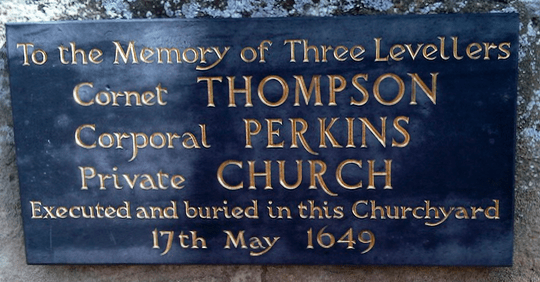
Levellers plaque

The sun always shines on Levellers Day. Look, I am as big a fan as anyone of Tom Paine’s The Age of Reason, but I have empirical evidence! Just in case you are new to my blog and require a little orientation as to the 17th Century Leveller movement, the Levellers Day site briefly explains what it is all about. For more details you can download a book from this site and I covered some aspects of the events of 1649 and their relevance to today in a recent blog post.

For me the day always starts with a lovely drive down from the Midlands along the Fosse Way and through the Cotswolds to Burford. I was delighted to be a ceremonial pikeman again this year so following a quick chat to my fellow Republicans it was away to the main tent to don my repro Civil War uniform.  Walking down to the Church from the Recreation field is always an amusing experience with smiles mixed with some bemused looks from tourists who are unaware of the significance of the day.

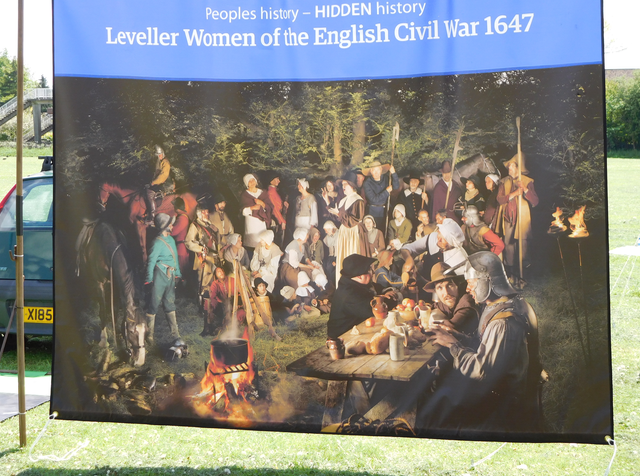
LevellerWomen

At the Church I meet up with my fellow Pikeman and Pikewoman to a welcome from the Sea Green Singers who open the proceedings splendidly with songs about the fight for tolerance and civil liberties covering over three centuries! Predictably, I loved their one about William Cobbett trying to repatriate Tom Paine’s bones (Cobbett was a truly fascinating character – learn a little more here).The address by Reverend Mark Chapman was as thought provoking and inclusive as always, managing to nail the common ground between people of many faiths and no faiths. This is followed by the laying of commemorative posies, a minute silence and a prayer from the Reverend.

Then we form up for the start of the procession – everyone is friendly, relaxed and in good spirits while we wait for the road to be closed. Once again we are marching up the hill all the way to the Recreation Ground.  With my fellow Pikeman, along with Rev Chapman and the Levellers Day banner bearers we closely follow the leading Morris dancers and marvel as they manage to keep going up the long drag. Extreme Morris Dancing for sure!

Levellers16


At the ground, a huge variety of groups are represented; Communists, Socialists, NHS supporters, Veterans for Peace, Trade Unions, the Woodcraft Folk to name but a few.  This year the Republic stall was even more popular than last year and I forewent the debate to help persuade more folk of the need to end inherited privilege.  This year the theme was (Un) Civil Liberties covering free speech and human rights. Friends tell me the debate was well up to the usual standard and I expected nothing less from the speakers involved! You cannot possibly agree with everyone and that is partly the point! But there is no doubt that the enthusiasm and commitment of others who have a passion for a different form of society, however they conceive it, is wonderful. There is an energy you can draw from this to recharge batteries for the campaigns in the year ahead. I am always grateful to Trish and her colleagues for the immense amount of work put into the day. A gorgeous time is finished off for me with a lovely drive back along the Fosse Way.

RepBrumLevellers

The inspiration from the day will last for a long time and it has already sparked fresh ideas and plans from the Republic Birmingham crew! If you’ve not experienced Levellers Day do come along to Burford next year. Its on the 20th May – put it in your calendar.

England’s New Chains Discovered: A Moment in History, A Warning To Us

Englands New Chains (1)
England’s New Chains Discovered

Last March (2016) I visited the Houses of Parliament for the launch of the We The People campaign for a Citizens Constitutional Convention. Like most visitors I entered through the Cromwell Gate right past the statue of the man himself.  It was a moment of reflection, with Levellers Day approaching (on 14th May 2016, more here) and the issue of democracy and accountability which it inevitably raises.

There is much popular misunderstanding about Oliver Cromwell and people are often confused about his place in history, asking whether he should be viewed in a positive or negative light. The unhelpful answer is both, depending on which aspect of his career is under consideration. As a reformer of the English Civil War Parliamentary forces during the creation of the New Model Army he was invaluable. In particular his organisation of the cavalry wing, the Ironsides was a crucial development in the eventual triumph of Parliament. But increasingly after 1648 he behaved in an autocratic manner, crushing tolerant and democratic forces (such as commemorated at Levellers Day) and culminating in the replacement of the Commonwealth by the Protectorate.

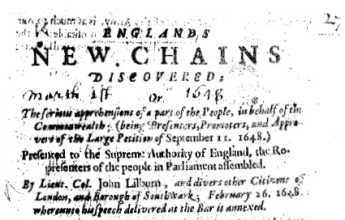
The increasingly repressive methods of Cromwell and his associates such as son-in-law Henry Ireton can be illustrated clearly in one event, which also serves as a warning to us. On March 28th 1649 four Levellers, John Lilburne, Richard Overton, Thomas Prince and William Walwyn were arrested for publishing (on February 26th 1649) a pamphlet called England’s New Chains Discovered (you can read a transcript here).  It was a clear and unambiguous criticism of Cromwell and outlined the dangers to liberty of the military government.  A crucial worry for the Levellers was the status of the so-called Council of State, the body set up to replace the Privy Council following the execution of the King and declaration of a Commonwealth in 1649. Set up by the Rump Parliament (you can view a transcript of the Act here), its 41 members were appointed rather than elected and Cromwell was its first Chairman. The dangers of such an arrangement were clearly laid out and included the ability of the Council to dissolve Parliament (then consisting of just the House of Commons, the Lords having been abolished) without the necessity to immediately call the next. Another grievance involved the ability of the  Commons to create or abolish Law Courts and so subvert the jury system which was regarded as the bedrock of justice. Likewise, the ability of MPs to be the ‘highest final judgement’ was viewed as particularly heinous as it placed them beyond the control of the laws they were enacting. That lawmakers should be subject to the laws they enact is regarded as a vital brake on any system of representative government. Central to all of this was the way in which senior army officers could sit in the Commons thus supporting military rule.

Continue reading “England’s New Chains Discovered: A Moment in History, A Warning To Us”

Whether By Incompetence or Malice, Muzzling Scientists is Bad News

It is sometimes difficult to decide whether a Government decision was the result of incompetence or an unscrupulous attempt to suppress debate.  Since we are frequently kept in ignorance, the viewpoint I take often depends of the charity of my current mood. It was revealed by the Observer newspaper in February (in this article) that the Cabinet Office was imposing new rules from May 1st 2016 which would effectively censor recipients of Government grants from using their results to lobby for a change in policy.  After a high profile protest by senior scientists, including the Astronomer Royal Sir Martin Rees, the Government has partly backed down (report here).  The problem is that the wording of the exemption is so imprecise that a researcher may be tempted to abandon a funding application for fear of contravening the rules. Likewise the sanction for such a contravention was not made clear

Why is this important? Firstly, it is the duty of all Governments to protect their citizens, not least from their own policies  and evidence of such harm must be made public.  The attempt to control and suppress such information is redolent of corrupt totalitarian regimes such as Nazi Germany or Stalinist Russia. Secondly, the Government Minister (in this case Matthew Hancock) seems to have forgotten that it is our money – there is no such thing as Government money. As I argued in an earlier post The Enlightenment of the 17th and 18th Centuries was built upon the ability to question and challenge authority using reason and argument.  This remains true today and public bodies have a duty not to restrict the ability of its citizens to access information which informs such debate.  There are many topics at the present time where the evidence is hotly contested, not least in Climate Change, Defence and Social Policy. So do I think the Government is bring incompetent or acting with malice? The original decision to muzzle scientists could be viewed as incompetent but the way in which the Cabinet Office is confusing the situation rather than making a clean retraction is inclining me to view the aim as yet another devious attempt to stifle opposition.

Thomas Jefferson: A Fatally Flawed Radical

Thomas Jefferson was a leader of the American Revolution, one of the Founding Fathers of the United States and a principal author of the 1776 Declaration of Independence. He became the second Vice-President (under John Adams) and the third President. He was a significant thinker and proponent of democracy and republicanism and there are many quotes expounding his ideas of liberty which resonate with us today. One I find significant is:

All, too, will bear in mind this sacred principle, that though the will of the majority is in all cases to prevail, that will to be rightful must be reasonable; that the minority possess their equal rights, which equal law must protect, and to violate would be oppression.

Something which we can also identify with is Jefferson’s warning of the dangers of corporatism, which was sadly ignored:

I hope we shall crush in its birth the aristocracy of our monied corporations which dare already to challenge our government to a trial by strength, and bid defiance to the laws of our country.

But the practical working out of his republicanism had a flaw which limited its application as the United States developed through the 19th Century. He was at heart an agrarian and influenced by the Country Party tradition of British politics. He saw society working best when it was a free collection of planters, small traders and smallholders which in many ways was a regressive concept harking back to a perceived agrarian golden era. Lest this be considered a criticism based on hindsight we can compare his ideas with his great friend and contemporary, Thomas Paine. Paine was an urbanite and correctly perceived that in the future land would be used for many purposes other than agriculture. Moreover republican theory would have to deal with the fast emerging capitalist culture. Paine’s solutions were very different and included, for example, the introduction of a Universal Basic Income to compensate the majority of citizens alienated from land ownership.

Continue reading “Thomas Jefferson: A Fatally Flawed Radical”

British Bill of Rights or ECHR, Value & Protect Your Rights

On Monday evening I listened to a radio news report about the Washington gunman. During the piece two American women were interviewed during which they stated that they were in the city on a tour of national institutions including the Supreme Court. It was a powerful reminder of how many Americans value their rights under the constitution. Now, despite not being a fan of the US Constitution, I wondered just how many Britons people were aware of their rights and how much value they place on them. This is in the context of a disingenuous UK Government who eternally seem to promise a British Bill of Rights ‘by next Thursday’! The fact that the government itself places such a low priority the reformulation of our rights calls into doubt their motives in government.

It was in the summer of 2013 during the Abu Qatada saga that the government considered a plan to withdraw from the European Convention on Human Rights (ECHR). During that incident and through the subsequent discussion on repealing the implementation of the ECHR in the UK, the Human Rights Act (HRA), it was often forgotten that the rights it asserts protects all of us: black, white, gay, straight..etc. Take an example from my personal experience. The fact that I advocate abolition of the monarchy in writing is clearly protected by the HRA as established in the 2003 Judicial Review brought by Alana Rusbridger and the Guardian newspaper. Although I value my right to freedom of expression very highly, but it is still relevant to consider the problems with enshrining human rights in an International Convention backed by a Court.

Continue reading “British Bill of Rights or ECHR, Value & Protect Your Rights”