John Osborne: looking back at a rebel

The brilliant and controversial British playwright John Osborne was born on 12 December 1929. Possibly his most transformative work was his 1956 play Look Back in Anger. Despite being associated in his early life with left wing politics, he claimed to hold to no firm political views. In his later life he turned towards a libertarian right wing stance, To his eternal credit, Osborne openly questioned the existence of the monarchy in his contribution to a book called Declaration. This was in 1957, a far more deferential age than 2015 and it got him into trouble! The chairiman of the English Stage Company industrialist Neville Blond was furious and a party to celebrate the publication of Declaration at the Royal Court Theatre was cancelled. Ironically, the ESC was no stranger to controversy itself. But I completely agree with Osborne:

My objection to the royal symbol is that it is dead; it is the gold filling in a mouthful of decay.
Edward VIII Abdication – A very British coup

On December 10th 1936 the uncrowned King Edward Viii signed the Instrument of Abdicated. Some details of the events leading up to the announcement are still shrouded in mystery but following the recent discovery of correspondence between the main protagonists the broad sequence of events is now clear. Despite the complexity of the situation there were two main reasons why the abdication came about. I want to leave aside the well-known associations with Nazism and focus on a couple of aspects which are relevant today.

As Prince of Wales the future Edward VIII had made himself unpopular with politicians. He had publically called left-wing politicians ‘cranks’ and made speeches criticising the Government of the day (of all persuasions). On succeeding George V he continued on a confrontational path with politicians in what we would today call an Activist King role.

Continue reading “Edward VIII Abdication – A very British coup”

Thomas Hobbes, advocate for autocracy

The political philosopher Thomas Hobbes died today (December 4th) in 1679. But as a civic republican I shall not be mourning him, for a number of reasons. Ironically for one of the founders of liberal and libertarian thinking (along with John Locke) a primary aim of Hobbes was a defence of sovereign power and autocratic government. Hobbes works include Leviathan, published in 1651 in which he developed his social contract theory. His work was partly aimed at opposing the radical politics which emerged during the English Civil War and the theories of the high Republicans during the Commonwealth of the early 1650s; the modern combination of which I find compelling!

So what lay behind Hobbes insistence on an absolute monarch (or ruling group)? It comes from Hobbes concept of society which viewed people atomistically, in perpetual motion trying to get economic power and influence over each other. From this a natural structure to society emerges with individuals all seeking their best interests. But if society is of this nature, what stops it falling apart in some kind of anarchic fight for ultimate power? Why, none other than a universally accepted absolute sovereign charged with passing laws to ensure the continued health of the competitive system. To keep the sovereign above the throng he or she would have the power to appoint their successor (what better than the eldest son!).

Continue reading “Thomas Hobbes, advocate for autocracy”

Shelley: The Continuing State of Things

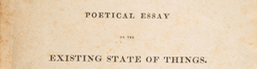
Shelley-Essay-1

Imagine discovering a new set of string quartets by the composer Beethoven. Or perhaps a large canvas by artist JMW Turner that was previously thought to be lost. In either instance, the media would have been all over it. So it is remarkable that the release to public view on 10th November of a major work by their near contemporary, the poet Percy Bysshe Shelley has been met with an air of disinterest, as though it really was not worth the bother. There were brief mentions in the mainstream media (The Guardian newspaper excepted) and some excerpts read out on Radio 4. No comments by Government ministers, including Culture, Media and Sport. But this was an early work by one of this country’s most famous poets!

The work in question is Shelley’s Poetical Essay on the Existing State of Things written in 1811. The only surviving copy of the poem has remained  hidden from public view in private collections for 200 years. You can now read (and even download a copy) from the Bodleian Library site.  So how did we finally get to read the work?  Poet and ex-childrens Laureate Michael Rosen has been campaigning for the release of the work for some time. Rosen gives his thoughts about the reason for the poem’s suppression and why he campaigned to get it released in this blog post.

Continue reading “Shelley: The Continuing State of Things”