The Queen’s Birthday Celebrations; a Cynical Exercise in Corporate Branding

A few weeks ago during April (2016) I was invited to celebrate the 90th birthday of a very wealthy and privileged Londoner I knew little about, had never met and was never likely to meet.  For me Elizabeth Windsor is a media entity with no more reality than, say, Sherlock Holmes or Daffy Duck.  I cannot truly say I never wish to meet the Queen since I have some questions I would like to put to our Head of State! A casual observer of the British media, however, may have concluded that I was almost unique in finding the whole situation bewildering, not to say nauseating. That I am not a casual observer is evidenced by the fact that I made a brief appearance in Stephen Smith’s biassed BBC Newsnight package on Republicanism. By the way, my balding pate can just be seen in the background at a Republic Birmingham meeting as CEO Graham Smith was interviewed. I mention it in case my fame suddenly accelerates and I am the subject of a future Have I Got News For You round!

Back to reality and the whole experience led me to reflect on how this preposterous situation came about and, more importantly for todays republicans, how it is maintained.  The conclusion was that we are the victims of a single event which allowed a psychotic chancer and a bunch of bandits to seize power, initially in England, almost a thousand years ago in 1066. Now, we cannot be sure how history would be different if Harold’s troops had not been duped into breaking ranks, handing victory to William the Conqueror (or more correctly William the Bastard). It may be that I would be encouraged to celebrate the birthday of an entirely different Londoner equally remote and unaccountable.

So how did we get from that moment to 2016? Initially, the shock of conquest combined with the application of the feudal system subdued the population with William allocating tracts of land to his invading Earls, who ruled absolutely and in the case of the North of England, genocidally.  Coincidentally with feudal overlordship a concept was promulgated which still finds some traction hundreds of years later, the idea that the King is the ultimate protector and guarantor of the security and liberty of the people. If your Lord is oppressive then you can petition the King who will either summon the miscreant for punishment or arrive in person with a body of troops to sort things out.  It was on this acceptance of the nature of the King which the leaders of the Peasants Revolt (incidentally triggered by the imposition of a punitive Poll Tax) met with King Richard II in 1381, during which the leader Wat Tyler was slaughtered. This should have been a warning, but there was another crucial factor at work.  The concept of a society without a King was literally unthinkable to the vast majority of the population in medieval times. The King was appointed by god and was the earthly kingdom’s link with the eternal state of heaven.  An appointed Head of State was therefore impossible and only a very few were aware of the ancient Roman Republic or he existence of the Serene Republic of Venice with its Head (the Doge) elected by a closed college system.

Continue reading “The Queen’s Birthday Celebrations; a Cynical Exercise in Corporate Branding”
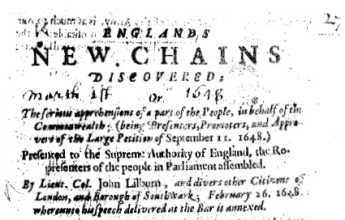
England’s New Chains Discovered: A Moment in History, A Warning To Us

Englands New Chains (1)
England’s New Chains Discovered

Last March (2016) I visited the Houses of Parliament for the launch of the We The People campaign for a Citizens Constitutional Convention. Like most visitors I entered through the Cromwell Gate right past the statue of the man himself.  It was a moment of reflection, with Levellers Day approaching (on 14th May 2016, more here) and the issue of democracy and accountability which it inevitably raises.

There is much popular misunderstanding about Oliver Cromwell and people are often confused about his place in history, asking whether he should be viewed in a positive or negative light. The unhelpful answer is both, depending on which aspect of his career is under consideration. As a reformer of the English Civil War Parliamentary forces during the creation of the New Model Army he was invaluable. In particular his organisation of the cavalry wing, the Ironsides was a crucial development in the eventual triumph of Parliament. But increasingly after 1648 he behaved in an autocratic manner, crushing tolerant and democratic forces (such as commemorated at Levellers Day) and culminating in the replacement of the Commonwealth by the Protectorate.

The increasingly repressive methods of Cromwell and his associates such as son-in-law Henry Ireton can be illustrated clearly in one event, which also serves as a warning to us. On March 28th 1649 four Levellers, John Lilburne, Richard Overton, Thomas Prince and William Walwyn were arrested for publishing (on February 26th 1649) a pamphlet called England’s New Chains Discovered (you can read a transcript here).  It was a clear and unambiguous criticism of Cromwell and outlined the dangers to liberty of the military government.  A crucial worry for the Levellers was the status of the so-called Council of State, the body set up to replace the Privy Council following the execution of the King and declaration of a Commonwealth in 1649. Set up by the Rump Parliament (you can view a transcript of the Act here), its 41 members were appointed rather than elected and Cromwell was its first Chairman. The dangers of such an arrangement were clearly laid out and included the ability of the Council to dissolve Parliament (then consisting of just the House of Commons, the Lords having been abolished) without the necessity to immediately call the next. Another grievance involved the ability of the  Commons to create or abolish Law Courts and so subvert the jury system which was regarded as the bedrock of justice. Likewise, the ability of MPs to be the ‘highest final judgement’ was viewed as particularly heinous as it placed them beyond the control of the laws they were enacting. That lawmakers should be subject to the laws they enact is regarded as a vital brake on any system of representative government. Central to all of this was the way in which senior army officers could sit in the Commons thus supporting military rule.

Continue reading “England’s New Chains Discovered: A Moment in History, A Warning To Us”

Thomas Jefferson: A Fatally Flawed Radical

Thomas Jefferson was a leader of the American Revolution, one of the Founding Fathers of the United States and a principal author of the 1776 Declaration of Independence. He became the second Vice-President (under John Adams) and the third President. He was a significant thinker and proponent of democracy and republicanism and there are many quotes expounding his ideas of liberty which resonate with us today. One I find significant is:

All, too, will bear in mind this sacred principle, that though the will of the majority is in all cases to prevail, that will to be rightful must be reasonable; that the minority possess their equal rights, which equal law must protect, and to violate would be oppression.

Something which we can also identify with is Jefferson’s warning of the dangers of corporatism, which was sadly ignored:

I hope we shall crush in its birth the aristocracy of our monied corporations which dare already to challenge our government to a trial by strength, and bid defiance to the laws of our country.

But the practical working out of his republicanism had a flaw which limited its application as the United States developed through the 19th Century. He was at heart an agrarian and influenced by the Country Party tradition of British politics. He saw society working best when it was a free collection of planters, small traders and smallholders which in many ways was a regressive concept harking back to a perceived agrarian golden era. Lest this be considered a criticism based on hindsight we can compare his ideas with his great friend and contemporary, Thomas Paine. Paine was an urbanite and correctly perceived that in the future land would be used for many purposes other than agriculture. Moreover republican theory would have to deal with the fast emerging capitalist culture. Paine’s solutions were very different and included, for example, the introduction of a Universal Basic Income to compensate the majority of citizens alienated from land ownership.

Continue reading “Thomas Jefferson: A Fatally Flawed Radical”

The Queen vs The Sun newspaper; End Royal Meddling in Politics

It is not often that I will jump to the defence of The Sun newspaper, in fact this may be the only occasion!  So firstly, the facts in brief. On the 9th March 2016 The Sun ran a front page exclusive  which claimed that the Queen supported Britain leaving the European Union (Brexit). There was speculation as to the source of this story, including ex-Deputy PM Nick Clegg and Michael Gove, both of which denied the leak. Claiming that the story was inaccurate, Buckingham Palace lodged a complaint with the Independent Press Standards Organisation (IPSO).  The argument in essentially that the story must be wrong because the Queen is politically neutral and did not, indeed would never, voice such an opinion in public.  The Sun has refused to name its source under journalistic confidentiality.  So we await the verdict of IPSO chairman Sir Alan Moses with interest.

These salient details are enough to draw a number of conclusions about the iniquity of Monarchy in the 21st century. Lets start with the fact that a free press has not only the right but the responsibility to report stories which are in the public interest. But specifically, there is an inherent unfairness at the heart of judging such a complaint. Firstly any investigation will require the Sun to divulge the source of the story.  The paper has every right to defend its source.  Roy Greenslade has pointed out  the fact that both of the main suspects have vehemently denied the claim together with the fact that the Palace will field a number of other witnesses besides means that the odds are stacked against The Sun. But IPSO will certainly be denied the possibility of calling the one witness who could clarify just what was said at the event, the Queen herself! Consider if it were you or I who complained to IPSO and then refuse to turn up to state our case. We would almost certainly lose – so why should it be any different for the Head of State? At the very worst IPSO should find that the claim was unproven and throw out the compaint. Here is an example of the injustice of a private individual who uses privilege to avoid accountability.

Continue reading “The Queen vs The Sun newspaper; End Royal Meddling in Politics”

Karl Marx: Earning a Living or Slaving Away?

Over the past two centuries one political philosopher has divided people more than any other: Karl Marx died today in 1883. You either love him or you hate him. But to simply reject or accept en bloc the ideas of this great man is to do him (and yourself) a disservice.  Although I am not a disciple of Marx, there are occasions where I find his ideas are right, or at least enlightening.  I’d like to take just one, wage slavery; as a Civic Republican anything which deals with slavery attracts my immediate attention!

Although Marx used it as a fundamental plank in his theory, the comparison between wage earners and slavery is an old one, being mentioned by the great Roman Republican theorist Cicero. In his De Officils he says:

…vulgar are the means of livelihood of all hired workmen whom we pay for mere manual labor, not for artistic skill; for in their case the very wage they receive is a pledge of their slavery.

Cicero’s view that wage earners were dominated by their masters was also common in Seventeenth Century England where many radicals (including Levellers) regarded them as having foregone their freeborn status and thus to be disenfranchised. In their defence, this was long before the industrial revolution changed the sheer scale and nature of earning a wage.  Later, Tom Paine took a more collective approach to try and eliminate the problem of wage slavery by support through state funds.

Continue reading “Karl Marx: Earning a Living or Slaving Away?”

William Cobbett and the Remains of Thomas Paine

On March 9th 1763 the journalist and politician William Cobbett was born. To describe him as a political radical would be misleading, but for much of his life he took a fiercely anti-authoritarian stance. Serving as a soldier in the British Army his early views were formed as a reaction to the corruption he witnessed amongst the officers while the enlisted men endured harsh treatment. Fearing persecution for his outspoken views he fled to France in 1792, where he found the revolutionary environment to be antithetical to his conservative approach. He immediately left for the nascent United States where he wrote pamphlets and articles supporting the British position.

Returning to Britain in 1800 he was offered the editorship of a Government newspaper which he declined in favour of his own publication The Porcupine which carried the motto ‘Fear God, Honour the King’. His next project The Political Register was launched in 1802 and initially took an anti-radical stance before drifting into increasingly virulent attacks against the Government of William Pitt for financial mismanagement and cronyism. The Register started to gain traction with the working classes and he was imprisoned for libel and, fearing a further prosecution for seditious writing, he returned to the United States in 1817.  While in the United States, Cobbett hatched audacious plan to return the remains to Britain of the great republican, revolutionary pamphleteer and political philosopher Tomas Paine, who died in 1809. Alas the plan to give Paine a granf reburial on home soil not come to fruition and Paine’s remains were found with Cobbett’s effects after his death in 1835, whereupon they were sadly lost to us.

Continue reading “William Cobbett and the Remains of Thomas Paine”

Bagehot: Living in a ‘Disguised Republic’

On February 3rd 1826 the businessman and journalist Walter Bagehot was born. He was author of a number of important works (including one on banking), but possibly most influential for us in the UK was The English Constitution, published in 1867. You can obtain a copy from this site. It is still frequently referenced today with the most oft quoted section regarding the British monarch who, according to Bagehot, has three rights:

…the right to be consulted, the right to encourage, the right to warn.

The work provided a kind of manual to the British constitutional settlement of the mid-19th century which is still largely relevant today. But it is not purely descriptive and Bagehot makes it clear that largely supports the status quo. The work itself is very much a product of its time and reflects the wealthy mercantile background of Bagehot. What stands out in the work is its suffusion with a sense of contempt for and distrust of those at the bottom layers of society. Here is one example:

The lower orders, the middle orders, are still, when tried by what is the standard of the educated “ten thousand,” narrow-minded, unintelligent, incurious.

Bagehot makes it clear that he considers monarchy is vital to provide a point of reference and national identity of ‘the lower orders’ who are otherwise incapable of understanding politics and government. Ignoring the cheerleading for a constitutional monarchy you can learn a lot from The English Constitution and there are actually some points on which I am  in agreement. For example in comparing monarchism with republicanism:

Continue reading “Bagehot: Living in a ‘Disguised Republic’”

Isaac Newton, The Enlightenment and Republicanism

Christmas Day 1642 saw the birth of a baby who would grow up to affect our world in ways unimaginable even to himself.  His name was Isaac (subsequently Sir Isaac) Newton. Why does this interest me as a republican? Because as a giant of the Age of Enlightenment his achievement symbolises a way of thinking which was becoming universal. His birth date was, to some extent, ironic.  For most of his life Newton was a mystic interested in alchemy and the goal of spiritual purification it represented.  Such was the astonishing success of his Theory of Universal Gravitation, however, that by the time of his death in 1726, there are indications that Newton himself had started to consider that a purely mechanical explanation of the Universe was possible.

So what were these new ways of thinking which caused a profound change? The Enlightenment of the 17th and 18th Centuries in Europe entailed the view that an understanding of the world could come from human reason.  Enlightenment thinking influenced almost all areas of human intellectual activity including the emerging sciences, art, philosophy and politics. Vital to the movement was an eagerness to question assumptions, to accept no authority as sacrosanct. As JGA Pocock put it:

 …the Enlightenment generally [was] based on a complete rejection of prophecy, revelation and the Hebrew mode of thought at large.

 J.G.A Pocock:   The Machiavellian Moment: Florentine Political Thought and the Atlantic Republican Tradition

What form did this new thinking take in the political arena? Before the Enlightenment, monarchs were considered to be the representation of the eternal truth of god which lay beyond time itself. From this we get the idea of a Divine Right of Kings. The notion of a time-bound head of state was literally inconceivable throughout much of Europe following the fall of the Roman Republic and the rise in dominance of Judeo-Christian orthodoxy. The century before the Enlightenment, however, saw rapid developments in political philosophy by a group of thinkers in Florence, Italy and, to a lesser extent, the ‘Serene Republic of Venice’. This explosion of thought in the late 15th and early 16th Centuries, (of which the most famous contributor today is Niccolo Machiavelli) slowly spread through Europe, fostering the idea that a nation could persist without its head of state being linked to an eternal god. Closely associated was a humanist concept which led to a concern during the Enlightenment with  ending the abuses of church and state.  From now on, liberty, progress and tolerance were to be underpinned by reason. But the move to a separation of Church and State was also attractive to many religious communities. It was all very well the monarch being a representative of god, but what happens if is is not your god? In England this all led to the effective ending of the concept of Divine Right in 1688-9 with the Glorious Revolution and the English Bill of Rights which I have blogged about here. This was only one year after the first publication of Newton’s theory in his Philosophiæ Naturalis Principia Mathematica.

Continue reading “Isaac Newton, The Enlightenment and Republicanism”

Two January 4ths, one decade and the world changes for ever

On January 4th 1642 an event happened which, more than any other, propelled England to Civil War. On that day King Charles I entered the Chamber of the House of Commons with an armed guard to arrest five Members of Parliament accused of high treason. They wre forewarned and escaped. Although tensions between Parliament and monarch over finance and religion had been building since the days of Charles father, James I, this event was significant.  From this point forward both sides start preparing for conflict.  The event is commemorated today  during the ceremony of the Opening of Parliament each year. As the monarch is not allowed in the Commons, the queen summons MPs to the Lords chamber. As he approaches the Commons chamber, the queen’s messenger, Black Rod has the door slammed firmly in his face. Sadly history provides numerous occasions since 1642 when the monarch has continued to interfere with parliament.

Continue reading “Two January 4ths, one decade and the world changes for ever”

Tom Paine: More times that try men’s souls

In December 1776 the American War of Independence was going badly for the rebel Continental Army. Led by a seemingly incompetent commander (George Washington) and in apparently endless retreat, morale was fast draining away. To raise spirits for the struggle ahead the leadership turned to one of the greatest political pamphleteers in history. Tomas Paine published his work The Crisis (or The American Crisis as it came to be known) on 16th December and it was read aloud to the assembled soldiers of the Continental Army on 23rd December. It commences with one of the most famous lines in the history of political activism:

These are the times that try men’s souls

Continue reading “Tom Paine: More times that try men’s souls”