Theresa May Curtseying To The Queen – What a Con Trick!

May Queen Cartoon
Cartoon by Peter Brooks for the Times Newspaper

Following her (unelected) installation as leader of the Conservative Party, Theresa May duly travelled to Buckingham Palace to be appointed Prime Minister of the United Kingdom of Great Britain and Northern Ireland. Pictures abounded of May curtseying to the monarch which naturally gave satirists and cartoonists like Peter Brooks (whose Times cartoon appears above) a field day.  But things are not all they seem.  In many ways a curtsey or genuflection can be classed with other acts of submission including swearing an oath which I have posted about here and here.  Bending the knee is about making yourself smaller than the other person, implicitly recognising their superior status. But Brooks was not alone in pointing to the shrunken nature of British democracy which allows a new Prime Minister without a popular mandate to be appointed by a Head of State without a mandate on any kind!  An insightful comment was made by Kelly Grovier in an article on the BBC website:

Though the photo may be accented with smiles and the glamour of designer fashions, a stony silence entombs this week’s image. It divulges nothing of what was actually discussed between the queen and the new PM.

This speaks to the wider issue about the secrecy which surrounds the upper echelons of government with Freedom of Information bans, secret weekly meetings between the Prime Minister and Queen and the necessity of obtaining permission from the Palace in certain circumstances to even hold a debate in the House of Commons! The message it sent to the British public was one thing, but to the rest of the world who may well view Brexit as a backward looking and isolationist act, such a picture serves to confirm an image of Britain as an out of date archaic irrelevance. Some posters on social media were quick to pick up on the symbolism and contrasted the stiff obeisance of the photograph with a picture of US President Obama fist bumping a floor cleaner as he walked past.  This reflects a totally different relationship of the Head of State to the citizenry.  There is no way anyone in Britain can truly identify with the Royals as the life experiences are totally alien. While not wishing a US style system for Britain, the fact that a Head of State drawn from the population and who shares at least some of the experiences of the people must be an essential requirement of the job.

A Deliberate Attempt to Deceive

But there are two ways in which the photograph is actually misleading.  At the end of her piece, Grovier makes a second telling  statement: In stooping low, [Theresa May] reaches high.  I have posted before on the fact that the powers of the Queen are largely wielded by the Prime minister in collaboration with her cabinet, termed a ‘disguised republic’ by Walter Bagehot.  So the curtseying picture is not representative and serves to perpetuate the myth of a Queen being above politics and ‘keeping them in control’. In reality the curtsey is almost a thank you by Theresa May for the transfer of power!

Continue reading “Theresa May Curtseying To The Queen – What a Con Trick!”
Fixed Term Parliaments; Reform Needs To Go Much Further

A few weeks ago I wrote a post on the unwholesome contract between the royals and senior politicians which lies at the heart of our unwritten constitution. Briefly, the monarch retains certain powers which in practice are exercised by Government, sometimes directly and sometimes via the Privy Council. In exchange for these so-called prerogative powers the monarchy gets to retain its remaining wealth and privileges. The royal prerogative thus allows the Government to exercise arbitrary control of dubious legality without the authority of Parliament. In a 2007 report, Gordon Brown’s government attempted an audit of these outrageous anti-democratic powers and concluded that their extent was effectively unknown. One, however, was known for certain: the ability to dissolve Parliament and appoint a new Prime Minister which gave the incumbent a great advantage. It allowed him or her to take full advantage of serendipitous events (a small war, for example) to catch the opposition off-guard and call a snap election.

The 2011 Fixed-term Parliaments Act changed all this and removed the power for the first time. It was sometimes claimed by opponents of the Coalition Government that the 2011 Act was a dark deed intended to shore up an unpopular administration for 5 years. Against this two points must be noted. Firstly, fixed term Parliaments were also a 2010 Labour Party manifesto commitment (along with starting work on a written constitution). Secondly, with the dual powers of dissolution given to Parliament nothing has happened thus far which would not have happened under the old system. It is, however, interesting to speculate whether a Fixed Term Parliament played a part in the Government deferring to the Commons over bombing Syria in 2013 (the first vote, which it lost) knowing that it could not take advantage of a temporary patriotic surge in popularity! The present concern is with the opposite problem. With the recent transfer of power from David Cameron to Theresa May and the appointment of a wholly new Government without submitting a manifesto and subsequent test at a General Election there are objections raised about the democratic legitimacy of the present arrangement. But this transfer would have also happened under the old prerogative arrangement!

Unfortunately there are other anomalies which the 2011 Act did not address. Some of these are highlighted in this excellent 2010 report from the Constitution Unit at University College, London. Importantly, although the focus has been on the term of Parliaments, other election and transition arrangements need to be formalised. The writ for calling an election is currently issued by government ministers rather than an independent body such as the Electoral Commission. Similarly the monarch under advice appoints the incoming Prime Minister who decides the date of the first sitting of Parliament. This must be regularised by making the first sitting a fixed time after the election during which an ‘Investiture Debate’ decides who forms the Government and implicitly appoints the Prime Minister. As the UCL document affirms, these changes would actually insulate the monarchy by further distancing it from possible electoral controversy. But in this case the concern is with misuse of arbitrary prerogative powers not by the monarch but by a Government or Prime Minister.

With numerous difficulties confronting our democratic system including poor representation, lobbying, corporate control of media outlets, etc, fixed term Parliaments might not have been top of the list of remedies. But Fixed Term Parliaments have been demanded by reformers since the 17th Century and my main criticism is that it did not go far enough! Clearly I continue to demand the removal of the monarchy in this country. In the meantime any steps taken to regularise and remove arbitrary powers are welcome. This would include the posited War Powers Act following two votes in the Commons on bombing Syria!

The Queen; 50 Years of Trying to Subvert the Commonwealth!

Royalists were unable to contain themselves during the summer of 2013. Apart from the birth of George Windsor there was also this report in the Daily Mail.  According to the article the Queen was ‘discreetly’ campaigning to make the Head of the Commonwealth a hereditary position. Apparently this included getting David Cameron to speak to the other Commonwealth leaders at the Commonwealth Heads of Government Meeting 2013 (CHOGM13).  Now, it must be said that the Daily Mail has been known to get things wrong! There was certainly nothing in the final communique, but maybe that was because it was very discreet. But lets make the entirely reasonable assumption the story is correct. Such an assumption is supported by the royals own website which deliberately confuses matters by having a Role of the Monarchy on its Commonwealth page. The Queen may currently be Head of the Commonwealth as a person but that is not true of monarchy as an institution. The idea that anyone could be promoting the extension of hereditary privilege in the 21st Century is simply disgusting. Furthermore, the fact that a change in the constitution of an international organisation would be attempted ‘discreetly’ shows the complete lack of respect that the Windsor family has for Commonwealth citizens.

The Mail was indeed correct in stating that the words ‘does not pass automatically to her heir’ had been removed from the Governance section of the Commonwealth Secretariat. The site, however, still emphasises the fact that the Head is chosen collectively by the member states.  What gives the story credence is that the Queen had already attempted to make the Head of the Commonwealth a hereditary position.  When the Letters Patent were issued in 1958 to make Charles the Prince of Wales it was intended that he, along with his heirs and successors, shall be future Heads of the Commonwealth!

Continue reading “The Queen; 50 Years of Trying to Subvert the Commonwealth!”

Cameron: a Retrospective

By Alison Rowland

I am delighted to welcome back to the Radical i-Pamphlet guest blogger Alison Rowland with a post containing her thoughts on the legacy of David Cameron. You can read Alison’s previous post In, Out, Shake it all About here; she can be found on twitter as @Rowland35Alison or check out her blog at https://leftologyblog.wordpress.com .

Cameron Tune
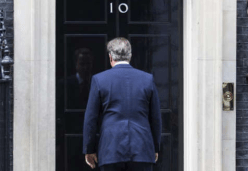
David Cameron steps back into Number 10 humming a tune.

I wanted to pause a moment and reflect, before the history books start to be written, before the entry which ends with ‘succeeded by Teresa May’ is written as if this happened as naturally as night follows day, to assess David Cameron’s contribution, his legacy. It’s all been said before, nothing new here, but I wanted to collect some of it together, before we all move on and forgot some of it. How bad it was.

He walks away with a little hum, and a ‘right, yes’, saying he’s going to leave ‘the s***’ he’s just navigated us all into to others to sort. It’s a day at the office for him, another day. Sometimes it’s been like a game for him and his chums (they are all ‘chums’ in the Tory party, apparently, when they are not stabbing each other in the back in the scramble for power). Nick Robinson compared it to Game of Thrones, and he should know because he was a close friend of all the Bullingdon boys.  Nick could have been there sharing all that power with them if he wasn’t busy producing a stream of right-wing propaganda for the national news organisation which helps keeps them in power.  He helps to share the power in his own way, by stifling other views.

It has been a series of days in the office.  But it’s really been all about power.  Sadly that job, that office Cameron has held has had the capacity to effect people’s lives. With the potential to harm them. And that Cameron seemed to enjoy. Or was it just collateral damage?  What kind of man pursues austerity so that people who work long hours caring for the sick, disabled and disadvantaged can barely afford to feed themselves? And does this whilst diverting money to the rich in the form of tax breaks and bonuses for bankers? What kind of man has a disabled child and loses that child, (a tragedy that would ruin many people’s lives for ever), but then goes on to demonise the sick and disabled?  Who refuses to help children escaping war who then drown in the sea, who sells off the profitable bits of the NHS and lets the rest rot away for lack of investment, and sanctions a system which classifies people with terminal illnesses as ‘fit to work’ so that the money they rely on for food can be reduced? What kind of person can do that, having had that tragedy happen to their family, even for power?  Is there no conscience there?  Just does it and then dismisses it all with a Pooh hum.

But there is more, lots more. Letting racism, intolerance and hatred breed, and pretending it’s nothing to do with you. But then acknowledging it, because it is part of people’s ‘legitimate concerns’ and moving your stance ever further towards more intolerance, more hatred, more dislike of anyone who exhibits any difference to your tribe.  Drip-feeding this hatred through the media, watching a party form to exploit this directly and split the vote against you so that you can hold ever more tightly onto power.  This after you have destroyed a liberal (‘Lib-Dem’) party with a great tradition of opposing such reactionary forces, destroying it by bribery and two-facedness, offering a bit of that treacherous power to a man gullible enough to take the offer, and then destroying him and that liberal tradition and that party without mercy.  Clearing the field so that you can have a stronger hold on that power.

Then when you’re close to the end, when you think you might be getting bored of these days in the office, when the game is getting a bit tiresome, thinking you might have a final fling. Seeing if you can finish off a rivalry you started at university, when you were both in a club where drinking and destroying things whilst drunk was the prime directive. The stakes are a bit higher now, but you’ve got that party of hatred willing to help you split opinion and pour more hatred on to fan the flames against Europe. That’ll make this game more interesting.  And yes, the old mate takes the bait, because you all love the prospect of power nearly as much as the realisation of it. And the press will help with more lies and hatred, and you know the left-wingers will struggle with their principles to know where to place themselves, and their discomfort adds to your pleasure. And gives your party a stronger hold on power.

It all goes pear-shaped in the end, but what the hell. Old rival doesn’t know how to deal with getting what he pretended to want, but no matter because you have a party full of people who’ve learned at your feet how to be even more greedy for power than you are. So you can go off with your ‘Ho-hum’ in less than three weeks.  And it was a breeze really. There was the odd tedious day at the office.  But overall, you and Gideon seemed to be having a good time. PMQs was, I think, for you one of the best bits – all that rowdy sexism, bullying, personal abuse – just like being back in the Oxford Union. The photos of you ‘having a laugh’ there say it all really. And the lucrative and very easy after-dinner speaker circuit awaits. More privileged drinking clubs. So you’ll never have to worry about money. Thousands of other families will, including those with disabled children, directly because of what you did. But not you, so that’s OK.

I’ll stop there. As he does. Retire gracefully. No longer pumped up for the fight. It’ll probably get worse for us all before it gets better. But I for one am glad the game is largely over for him. I hope he has days of regret, of conscience, in the time left to him. I hope occasionally he thinks of those other families, and wonders whether it was all worth it. When he is old and his health fails, and he starts to become like those he despised and tried to get us all to hate. I hope he wonders if it was worth it.  For the power, the very brief and fleeting power, it doesn’t last.  But the damage does.

Prince Andrew’s Activites Blows the Myth of a Monarchy ‘Above Politics’

The scandal involving Prince Andrew trying to broker a ‘deal’ with an unsavoury Kazakh oligarch highlights just why we should be worried about the way the monarchy interacts with our Government. The myth that the royals are somehow ‘above politics’ is the illusion most zealously maintained by Buckingham Palace and only rarely do the real facts emerge and then frequently in a distorted form such as when the queen accidentally advised the Scots to exercise care when voting in the Independence Referendum. But we must remember the constitutional settlement where the monarchy gets to retain a privileged and wealthy existence (I have argued that they are actually addicted to it) in return for politicians using the archaic power of monarchy and to do their bidding when requested. The archaic power is operated through the Royal Prerogative and allows the Government to exercise autocratic control where the legal protections to citizens are at best unclear. This is a whole issue in itself, but let’s return to the Prince Andrew scandal.

Continue reading “Prince Andrew’s Activites Blows the Myth of a Monarchy ‘Above Politics’”

Brexit; We Need Radical Policies Urgently, Not Ignorant Careerists

Article50

The most shocking thing about the Brexit vote has not been the result but the collective failure of the political class to give any sort of coherent leadership.  Instead, we have witnessed, by turns, politicians frozen like rabbits in headlamps.  Look at the facts, chief dissembler Boris Johnson, supposedly intelligent appeared the morning after the vote, said nothing and scuttled away.  David Cameron blubbed to the media and similarly retired hurt, but bear in mind he still has responsibility as Prime Minister! Chancellor George Osborne simply did not appear at all until Monday morning when he popped up with neither clue nor plan but long on soothing platitudes. The rest of them including Michael Gove just responded by a starting to think about their careers and a leadership election.  Some commentators have called it Machiavellian, but having spent a little while looking at the work of ‘Old Nic’ I reckon he would most probably have been appalled at the incompetence! All the Parliamentarians, including the Labour party self declare as democrats but are prepared to risk leaving a dangerous power vacuum.  There were even calls, not serious ones admittedly, for the Queen or Army Generals to take temporary charge! A few weeks later and their democratic credentials look even thinner with the Conservative Party preparing to elect a new leader and thus Prime Minister from an electorate of only 150,000 without the guarantee of a General Election and the possibility of rowing back from the Brexit vote (Article 50 will not now likely be triggered until at least 2017).

A Failure of Planning and Understanding

A almost incredible facet of the referendum result was the total lack of planning for a leave vote.  Racist incidents soared, the currency and stock markets collapsed and international collaboration immediately started to freeze or be terminated.  But no one took control and we are far from out of danger, in fact the danger will actually intensify. This was the inevitable outcome of the debate which was criticised in earlier posts here and here. I do not buy the argument that we will experience some volatility before things settle down. As things transpired only the SNP in the shape of Nicola Sturgeon were anywhere near prepared for the result.  No wonder the SNP virtually monopolise Scotland, a state of affairs which does them credit but bodes ill for contestable politics in the UK.  Here is why I think this is the case.

Continue reading “Brexit; We Need Radical Policies Urgently, Not Ignorant Careerists”

Now More Than Ever UK Republicans Must Present a Positive Vision

In recent times republicanism in the UK has presented itself to the public consciousness as a negative concept, defined by opposition and protest rather than a vision of what it represents.  This is understandable since the central core of republicanism has largely been the pursuit of an anti-monarchy agenda.  Similarly, wider concerns have often been characterised by an oppositional stance, abolition of the House of Lords for example, or the disestablishment of the Church of England and the removal of Archbishops (Lords Spiritual) from the Upper Chamber. Like my fellow republicans I too am highly critical of the outdated unearned privilege the Royals enjoy, in part because it is much easier to say what you oppose than clearly defining what it is that you want. The problem with this approach is that it is limited and ultimately doomed to failure. If people are going to identify with a position they must be able to ‘buy into’ an idea.  We can see this elsewhere in society but most clearly in the commercial world; Samsung will attempt to sell their phones by promoting price, features, functions or quality and only obliquely refer to the competition, stopping well short of saying their competitors are rubbish. Now in the post-Brexit mess in which we find ourselves, understandably worrying to so many of our fellow citizens, UK republicans must present a positive statement of the case; we must sell them a positive vision.

History shows that an anti-monarchy message alone is insufficient

Historically the advance of republicanism has been associated with campaigns with wider currency. For example. at the high water mark of English Republicanism in the mid-seventeenth century the calls for a republic were the natural outgrowth of a campaign for the establishment of civil liberties and religious tolerance. Likewise in a second wave of republicanism in the nineteenth century, it was associated very closely with Chartism and the campaign for greater participation in political decision making, relief of grinding poverty and  the promotion of workers rights. Similarly, today republicanism is a natural corollary to many other demands which cut across party political lines (see my not just a leftist concern) and the abolition of hereditary and many other sorts of unearned privilege can be presented as an inevitable consequence of a new vision which chimes with the aspirations of young people in particular.

Promoting positive visions of Republicanism

So what are the positive message which we can promote as republicans.  There are many, but here are just a few ideas. Starting with the more narrowly focussed campaign for a change to our head of state, in some cases they are the mirror images of campaigns already mounted by the Republic campaign group. For example the campaign to end royal secrets leads more widely for a call for far greater openness in Government in general.  Republicans should overtly campaign for such a policy. On the other other hand, I know from personal experience in street and event level campaigning that the #bornEqual campaign cut through with the public and this can be followed up with similar positive visions of a republic which places the promotion of the common good as a central facet. Likewise the interconnection of individual freedom and civic participation is of overwhelming importance following a referendum campaign dominated by a few high profile individuals peddling  misinformation and outright lies.

As Republicans we must make every effort to present the positive case. The UK is passing through a tumultuous time and it is possible that as a consequence, greater intolerance and loss of liberty may be the long term outcome.  We have a message of an open and tolerant society which WILL resonate with many fellow Britons. Over the next few weeks and months in my blog I will develop further how republican ideas can be positively promoted.

‘Taking Back Control’; Sounds Fine if You Like Illusions

Crowned_Portcullis_Med

On the face of it the Tesco Superstore in Consett, Co. Durham is not the most obvious place to gain insight into the EU referendum debate. On the other hand, it is as good a place as any (including Westminster and Whitehall), which gets to the heart of the problem. I popped into this particular store a couple of week ago while paying a visit to the area and while queuing to check out, overheard a young man operating an adjacent till enthusiastically explaining to his paying customers why he was voting to leave. It was, he confidently asserted, all about sovereignty, about taking back control. This set me thinking about the multi-facetted layer of the debate and the way in which ‘taking back control’ has eclipsed the Remain campaign’s point about protecting the rights of part-time and low-paid workers.

‘Taking Back Control’ – to Where?

The deliberate conflation of sovereignty with taking back control is only possible due to the depressing lack of understanding amongst many people of even the rudiments of the British constitution. The intention of the Leave campaign is to give the illusion that somehow we are all in control, an illusion of popular sovereignty fostered by the holding of the referendum itself (Ben Wellings and Emma Vines have pointed to this irony).  Theoretically, sovereignty the UK is exercised by Parliament with the role of the people limited to choosing their representatives to exercise this sovereignty.  Under normal circumstances the young man at the Tesco checkout would have very little power unless he got himself elected, or elevated to the peerage, and even then his power would be limited.  But even those who proclaim the supposed sovereignty of Parliament are being misleading and in fact the UK has a long history of internally sharing sovereignty.  As a prime example, the Scottish legal system operates on a completely different set of assumptions to the system in England and Wales. In modern terms the Parliaments and devolved assemblies of Wales, Scotland and Northern Ireland all share some of the Sovereignty of Parliament along with the English judiciary (through the system of common law). The official website provides more information on the number of ways in which it actually shares sovereignty with other sources of UK power. For a more complete account of the background to shared sovereignty, David Allen Green has written this excellent post.

So far I have considered  the UK in isolation. But we are signatory to approximately 700 or so international treaties, each of which involves a sharing of sovereignty to a greater or lesser degree.  Three of the most prominent agreements of course are the North Atlantic Treaty Organization (NATO) United Nations (UN) and the European Convention on Human Rights (ECHR).  It could be argued that as the UK parliament could withdraw from any international treaty then it still exercises ultimate sovereignty.  But turning us into a kind of North Korea is not what the Leave campaign advocates. In fact it positively encourages us to be outward looking and even lauds the Commonwealth, which is in itself an expression of shared sovereignty! So the concept of sovereignty is a complex issue with many layers and a troubled history.  David Nowell Smith gives further details of just how slippery is the concept of sovereignty.

Who Would Exercise this ‘Control’?

While acknowledging just how complex the concept of sovereignty can be, it is possible to address some issues surrounding the wielding of power in the UK. Behind the deliberate conflating of sovereignty with ‘taking back control’ is the implicit assumption of an increase in individual liberty.  We have already noted that our checkout person will have almost no more effective power if we leave the EU than if we remain.  One example will suffice to illustrate this important point.  Many Leave campaigners talking about control are actually alluding to one aspect, immigration.  The argument is that withdrawing from the EU will necessarily drastically slow immigration leading to both higher wages and more resources for all of us in terms of public services.  But this is a deception. With sovereignty resting with Parliament and government being elected on a minority of the voters (the current one by only 37%, 24% if you include non-voters) there is no reason why a right wing government could not skew immigration to provide a constant flow of workers into just those industries to keep wages suppressed. Likewise there is no guarantee that more will be spent on public services, austerity may well continue and services privatised. Don’t forget, the Government has been stocking the Lords with wealthy businessmen interested in making as much money as possible.

Continue reading “‘Taking Back Control’; Sounds Fine if You Like Illusions”

The House of Commons Chamber is a Museum Piece Unfit for Purpose

How old is the Chamber of the House of Commons? If you didn’t know, a reasonable guess may be that it is an eighteenth or nineteenth century structure. Although there have been buildings on the site since the 11th Century, the Palace of Westminster as a whole largely dates from the 183os. Surprisingly, however, the fabric of the present Commons Chamber itself dates from only 1950 when it was rebuilt following destruction in wartime 1941!

The striking thing about the EU referendum debate is the way in which politicians from all parties have been willing to share a platform. But this is not exceptional with the Parliamentary committee system allowing politicians to work together to achieve mutually agreed goals. This is at odds with the undemocratic charade to which Prime Ministers Questions has now descended in the main Chamber. In the current disillusionment with politics and the political establishment, one problem which is often overlooked is with the structure of the Chamber of the House of Commons itself. You can view the layout using this very good interactive guide. Incredibly for our main legislative chamber it can only seat 427 of the 650 MPs! The situation is exacerbated when the governing party (or coalition) has a substantial majority flooding one set of Chamber benches.

In terms of layout, the format of two banks of benches facing each other is, appropriately enough, known as Westminster Style. Considering the problems associated with this arrangement very few new legislative chambers are designed in this way. What are the problems? Firstly it does not facilitate good debate, partly because it encourages a confrontational approach between Government and Opposition often leading to the unseemly jeering and barracking with which we are all depressingly familiar. Moreover, exchanges between members on the same side is hampered by the fact that participants cannot see each other easily when arranged side-by-side.

Continue reading “The House of Commons Chamber is a Museum Piece Unfit for Purpose”

The EU Referendum Debate; Insults and Bluster Hides Dangerous Policy Vacuums

In early March I was delighted to host a guest blog post on the subject of the EU Referendum debate by Alison Rowland. In her piece, Alison pointed out that even then the debate was being framed around the issue of sovereignty without any real content or substance to the argument. Two months later and, if anything, the level of debate has reached new depths of depressing inanity and danger in its level of superficiality. There has been no advance on the problem highlighted by Alison where people seeking answers and guidance on fundamental issues are met with politicians throwing around comments on Hitler, engaging in power games and trading personal insults.

Both sides are guilty of this approach. For the Brexiters the very autocratic power they claim to be wielded by Brussels also operates in the UK – an unaccountable monarchy system, the Privy Council and Royal Prerogative for a start. It appears they want power for the few with little accountability or control over the exercise of that power by citizens. We need to know the nature of this supposed recovery of sovereignty, how it is to be exercised and for whose benefit.  Furthermore we are presented with no plans for filling the gaps in workers’ rights, LGBT rights etc.

Listening to the Remain campaign is similarly infuriating.   Depending on the European Union for rights presents an equal danger. The argument that we are dependant on a benign EU for protection of citizens is not something with which we should be comfortable. What if we are entering an era where the EU is a far less benign force (as indicated by the TTIP negotiations and an autocratic Central Bank arrangement)? Furthermore, it seems that the Remain camp are not allowing for the possibility of the EU falling apart whether or not we stay; a distinct possibility with the strains of the refugee and financial crises If the rights are important let us enact them in the UK independently of the EU. To an establishment which has boasted about the Magna Carta it is incredible that we cannot set up these protections for ourselves.

For both sides there is appalling lack of planning and timetable for reform. We ask the questions but get the same stock answers seemingly culled from the playbook of Brexit and Bremain with no real thought of what is being said. I spent last Saturday at the wonderful Levellers Day in Burford (my post here) and wonder what the Levellers and other parties to the great mid-17th Century debates would make of the current superficial approach to the development of our rights. Maybe the epithet that we get the politicians we deserve is correct after all!