It Is Almost 50 Years Since Jack Ashley Became the World’s Only Totally Deaf Lawmaker – But What Has Changed?

thumbs-up_318-31579

Last month (March 2017) Dawn Butler made history by becoming the first MP to use British Sign Language (BSL) to pose a question in the House of Commons. She asked whether the Government would give BSL a legal status alongside other recognised languages.  As Ms Butler said in a subsequent article :

We need to make parliament representative of wider society. One important part of this is to make parliament as open and accessible as possible.

Representation Means More Than Voting and Consultation

This is a crucial point. Vital in any inclusive political system is the ability for all groups in society to be represented and influence every aspect of Government policy, not just be called into committees when the members feel like it! Inclusion means having an input in the formulation of policy in the first place rather than being limited to commenting and voting on the agendas of others. In a review of political representation of women and BME communities Karen Bird quoted researcher Melissa Williams:

“…the only hope that marginalised group presence will have a lasting effect on policy outcomes is that decisions are based not only on the counting of votes but also on the sharing of reasons.”

The same argument, of course, applies to any other community group. But consider the figures. In the current House of Commons (April 2017) between 2 and 5 MPs are considered physically disabled, depending on the criteria applied.  Yet to be representative, on even the more narrow of definitions of diability, there would need to be 65 MPs.

Continue reading “It Is Almost 50 Years Since Jack Ashley Became the World’s Only Totally Deaf Lawmaker – But What Has Changed?”

The Article 50 Letter Focussed on Economics and Security; But Theresa May Was Threatenening Us Not The EU!

In her letter to the European Commission formally giving notice of the UK triggering Article 50 to withdraw from the EU, Theresa May made specific reference s to two areas of policy, economics and security.  Linking these was widely interpreted as a veiled threat to ensure a more benevolent negotiating position from the EU countries.  While this may be correct it is far from the whole story. There was another audience – us! Economics and security go to the heart of the disastrous policies which this amoral government is intent on pursuing.

Focussing on economics and security as a combination (as opposed to say, social policy or the environment) is entirely consistent with Theresa May’s pursuit of the kind of autocratic neo-Conservatism I have alluded to in an earlier post.  The implicit threats of a ‘bonfire’ of red tape presents a real danger to the rights and conditions of working people.  This means that Sports Direct and JD Sports warehouse conditions will become the norm rather than the exception. Add this to Chancellor Philip Hammond’s threat turn Britain into an offshore tax haven, effectively ending the possibility of adequately funding public service provision and the scene is set for wage slave conditions and the return of the workhouse. May’s clever move was to present such a prospect up front in an attempt to gain misplaced patriotic support at the expense of individual rights, as I pointed out here.  The argument will be that we shall need to work in this manner in order to show the big bad EU that we can run a ‘successful economy’.  You can almost hear the rhetoric now; cutting red tape to unleashing the creative potential of plucky Brits in the ‘gig economy’ to thrash those Johnny foreigners in the EU! In reality the only things unleashed will be the size of the bank accounts for the likes of Philip Green and Mike Ashley.

Consider the second point of emphasis, security.  As a result of the events in Westminster Parliamentary attacks, Home Secretary Amber Rudd is already proposing breaking into encrypted messaging services in the name of ‘security’. This is in spite of the evidence to suggest that it was a lone wolf attack, the most difficult to stop using correspondence surveillance.  But the revelations from the CIA reveals that without strict and accountable line of authority such technology cans be used for more than just extremist terrorism.  There is nothing to stop future governments (also conceivably led by that nemesis of Human Rights, Theresa May) broadening ‘threat’ to include the EU itself if negotiations go wrong (as seems likely) or ‘environmental activists’ as has already happened in local instances. As I mentioned in a previous blog, Government can harness the natural instincts of people to gather closer together for protection.

The autocratic part? Aside from continued attempts to exclude Parliament from taking an active part in Brexit, todays white paper on the Great Repeal Bill makes specific reference to the Government taking ‘delegated powers’.  Even as it stands it is anticipated that up to 1000 instances of Ministers making alterations to statute while bypassing Parliament will occur.  The likelihood is that number will explode with ample opportunity for the Government to sneak through legislation which is only remotely related to EU separation.

Make no mistake, the Article 50 letter was as much for our consumption as for the EU Commission.  Brexit has provided the perfect opportunity for the Government to pursue its neo=Conservative policies.  But they were going to be pursued anyway. If Brexit had not happened another pretext would have been found.

When Replacing the House of Lords we Must Balance Democracy with Inclusive Representation

Thanks to a constitution where elections prevail throughout the system the United States now faces one of the most hazardous moments for individual liberty in its history.  It provides a warning about the dangers of a fully elected second chamber which is often suggested for the UK.

Currently in the US one party holds the Presidency and a workable majority in both houses of Congress. Moreover this is a party being dragged away from consensus politics by a charismatic leader intent on enacting policies which present a threat to the constitution itself. The situation is made worse by a willingness to appoint members to the US Supreme Court on a partisan basis which shows signs of destroying the balance of opinion for years or possibly decades.

There is now a real danger of what Alexis de Tocqueville in the nineteenth century called the ‘tyranny of the majority’, a situation where the Government takes action supported by the majority of voters which significantly harms the rights of minorities. To be strictly accurate, through a quirk in the Electoral College system the United States is in danger of falling into a tyranny of the minority! All this means that significant autocratic power (through Executive Orders and sackings of Government Officials) is being wielded by a President intent on pursuing an oppressive agenda.

It is for these reasons that while replacing the House of Lords is an urgent task, to make it a fully elected Chamber would be a mistake.  Instead a new upper-house Senate should be only part elected with the majority of Senators appointed – but by a system vastly different from the present one. This would enable us to give legislative responsibility to groups which at the present time are grossly underrepresented in Parliament.  Underrepresentation may occur for any number of reasons, for example, disability or prejudice against being selected by major political parties as candidates.

Appointed Senators will allow us to balance experiential gaps in the lower chamber. At present such groups are only consulted on specific pieces of legislation as expert witnesses.  But it would be far more effective to have the possibility of every piece of legislation reviewed by, say, a  group of blind or wheelchair-bound Senators.

Clearly the size of the new Senate must be greatly reduced from its current bloated size stuffed as it is full of toadies, oligarchs and the left-overs of an autocratic past.  For this reason the second Chamber would have specific responsibility for liaising with special interest and civil society groups outside Parliament. Finally the appointment of Senators must be taken out of the partisan political domain with citizen nominations to the Senate overseen by an appointments commission. Such a commission would have a specific remit, for example, to check that nominees are resident in the UK for tax purposes. Nominees who do not meet these criteria will not be considered further.

Final selection would be undertaken by a citizen panel which would be drawn in a similar way as a jury but on a national basis.  Appointments would be made for a fixed period, for example 8 years, which could be renewed once by agreement of the citizens panel.

The existence of such a Senate would mean the Government working much harder to ensure legislation is fair to all sections of the community. While certainly not ruling out wealthy Senators, the possibility of decisions hinging on people such as Andrew Lloyd Webber flying in for the express purpose of passing oppressive acts (such as the Tax Credit Cuts) would be eliminated. Likewise the increase in Senators committed to doing a competent job will mean the body is fully able to examine evidence on the effectiveness of enacted legislation and hold the Government properly to account. This is currently a woeful inadequacy of our system

It would also mean the feared suppression of rights which may occur in the United States over the next four years would be minimized!

‘A Powerful Hand’; Innovative Radical Journalist Peter Finnerty

Fiercely contested court cases, attacks on the judiciary, personal abuse and subversion of Parliament.  Sounds like 2016, but this was over 200 years ago in 1811. At the centre of it was Irish journalist Peter Finnerty.  Almost unknown today, Finnerty was the beneficiary of one of Percy Bysshe Shelley’s great early works Poetical Essay on the Existing State of Things (you can read more about the radicalism of Shelley’s Poetical Essay here), but his influence at the time was far greater. Finnerty possessed a keen perception of how state institutions could be utilized to gain public attention and saw many opportunities for advancing his radical ideas in novel ways, some of which are applicable today.

Born sometime between 1766 and 1778 (sources vary) in Lochrea, Ireland, Finnerty became a printer in Dublin and published The Press, a nationalist paper founded 1797 by Arthur O’Connor. That same year the British government prosecuted The Press and Finnerty was tried for seditious libel following strong criticism of the judges who sentenced United Irishman William Orr to death along with Lord Camden, the Lord Lieutenant of Ireland who turned down an appeal for clemency. Finnerty was tried in early 1798 and sentenced to two years imprisonment and time in the pillory.  On his release, Finnerty moved to London and worked as a reporter on the Morning Chronicle newspaper while engaging in radical activism. This included the Robin Hood Society, notorious amongst establishment figures for, amongst other things, actively campaigning against the George III Golden Jubilee celebrations of 1809.  In 1811 Finnerty was again sentenced to prison, this time receiving eighteen months for libeling Minister of War  Lord Castlereagh during a highly critical report on British military command during the 1809 Walcheren campaign against Napoleon.  Incredibly, Finnerty used the imprisonment to keep the issue of Castlereagh in the public spotlight and repeated the libel on a number of occasions. In 1811 jail was a tough place and inmates had to provide for themselves. As a result, Finnerty’s friends and associates organized events to raise money for his maintenance inside jail with Shelley’s contribution being the proceeds from his poem Poetical Essay.

Finnerty is fascinating for a number of reasons.  Firstly he was one of the first activists to use journalism as a method of developing and promoting a radical political platform. Secondly. Finnerty missed no opportunity in trying to destabilize government by petitioning Parliament on all kinds of issues including the conditions of his imprisonment. Thirdly his use of court cases, even ones he lost, as a means of keeping issues in the public gaze was masterly.

Finnerty was a thorn in the side of Government using investigative journalism to cast doubt on the veracity of Governments officials and even witnesses in trials. Finnerty’s aim was the emancipation of the Irish people and the promotion of a mainland radical and republican agenda and the techniques he used can still be deployed today. But they are as equally available to reactionary and oppressive forces as to progessive ones. We need only look at the virulent attacks on the High Court and Supreme Court judges by the Daily Mail which briefly included drawing attention to the fact that one of them was a gay Olympic Fencer! These disgusting and scurrilous articles are serving the aims of an oppressive oligarchy which are very different from those of Peter Finnerty

Banker Mark Carney; Secret Plans Show an Instinctive Avoidance of Accountability.

During World War II, much to the annoyance of his leader Clement Attlee, Aneurin Bevan insisted on holding Prime Minister Winston Churchill accountable for his actions. His reason was twofold; firstly believing that it was absurd to fight an authoritarian regime to simply abandon it at home and secondly, the belief that no matter how effective Churchill appeared to be, mistakes and inefficiencies were possible. I think Bevan was right

So the recent reports of Bank of England Governor Mark Carney holding confidential dinners with investment bankers and finance directors should ring alarm bells. The rumours of ‘secret deals’ as reported by The Independent newspaper is unacceptable. But as a banker, Mark Carney is naturally inclined to avoid accountability. Take two of the international groups which Carney is a senior member (for now),  the European Systemic Risk Board (ESRB) and the G20 Financial Stability Board. Neither of these bodies have any form of democratic accountability. Incredibly, the ESRB which has responsibility for avoiding another 2008-style crash is run by the European Central Bank (ECB) along with individual National Central Banks, the very people who failed to see the disaster in the first place. The ESRB, of which Carney is a Vice-Chairman, makes politically sensitive decisions and the fact that it that merely reports to the European Parliament is dangerously misrepresented as accountability. Lack of proper control means these bankers cannot practically be fired, demoted, reprimanded or subjected to a pay cut!

Make no mistake, Carney is either being disingenuous or simply naive in  claiming he is not behaving politically. The idea of an independent Bank of England is a fiction and the role of Governor in particular is highly political. But in any case the demand that banks and regulatory authorities should be independent has somehow come to imply that these bodies are unaccountable. For all the populist nonsense about him being a ‘rock star banker’ he is a public servant paid by you and me and we have a right to know what he is telling these financial special interest groups. This is especially so when his audience wield considerable influence as donors of the Conservative Party. Irrespective of the issue of Brexit the stench of oligarchy is strong and inevitably provides more fuel for extreme right wing advocates . Carney tries to dodge accountability under the guise of acting in the best interests of the nation but as Bevan would clearly have understood, this must be demonstrated openly.

Senator Bernie Sanders is Right About Oligarchy; But the Warning is Over 2 Thousand Years Old!

We humans pride ourselves on our ability to learn and adapt. So it must be a triumph of greed over intellect that well we fall into the same traps despite being warned about them for over two thousand years!!. Nowhere is this more stark than with the rise of oligarchy, the problem where a small group of people gain control of a country or an organisation. Writing as long ago as the 4th Century BC the philosopher Aristotle identified oligarchy as a deviant form of aristocracy and pointed to  two specific aspects which concern us at this time.  Firstly he regarded wealth as the important issue in the rise to prominence of a few powerful rulers.  Secondly, he regarded an oligarchy as ruling solely for its own benefit (hence deviant), disregarding the plight of the poor and dispossessed.

So its worth spending a little time finding out what we can learn from the beardy old Greek thinker. Aristotle warned that rule by the few alone (just like the rule of an absolute monarch or unrestrained democracy) is unstable and liable to collapse. In fact in America and Europe today the power of the few has grown markedly while the power of democratic forces have been consequently in decline.  In the US this is exactly the danger which former Presidential candidate Senator Bernie Sanders has been warning about.  As a result, aside from the election of Trump, it has brought about an increased threat of instability and authoritarian government in almost every western country.

But we can learn a lot more from those old Greeks.  For a start, Aristotle was writing from experience of oligarchic rule which mobilised sages, poets and artists in the maintenance of their power.  Discussing public speech in a republic, Barry Strauss noted that:

The Sophists, with their corrosive relativism, taught rich and talented young greeks that power was better than truth.  Socrates [Aristotle’s illustrious predecessor] sat out the civil war in Athens between democracy and oligarchy at the end of the Peloponnesian war’.

Who were the Sophists? They were peripatetic intellectual coaches who taught the children of wealthy ‘excellence’ in order to gain power and fame. So little difference from our modern day Eton, Harrow, Oxford or Cambridge, apart from the fact that the students travel to them rather than the other way around!  Strauss’s point about corrosive relativism is telling with ancient poets and artists now being replaced by journalists, branding and PR experts employed in media outlets.  Today we call it ‘post-truth’ journalism, beloved of both the hard copy media such as The Sun newspaper and online outlets such as Breitbart. Socrates may have ‘sat out’, as Strauss puts it, the civil war in Athens between democracy and oligarchy, but such disengagement is not advisable in the modern age or we may experience the reappearance of the find the mass slavery of his time.

In the Spirit Level book Richard Wilkinson and Kate Pickett pointed out how initial wealth inequalities become entrenched into a class system.  They state:

Over time,  crude differences in wealth gradually become overlaid by differences in clothing, aesthetic taste, education, sense of self and all the other markers of class identity. Think for example of how the comparatively recent emergence of huge income differences in Russia will come to affect class structure.  when the children of the new Russian oligarchs have grown up in grand houses, attended private schools and travelled the world they will have developed all the cultural trappings of an upper class.

Apart from Russia, there are many examples of this happening, especially in the United States.  Already some members of the Democratic Party speak of persuading the Clinton daughter Chelsea to stand for President thus proving that at least some are intent on repeating the disaster of Hillary’s candidature. The only saving grace is that the Trump family look to be making the same mistake with daughter Ivanka raising eyebrows with her presence at some early high level meetings alongside her father. To the great surprise of almost no-one, rather than ending the Washington oligarchies, Trump is simply replacing them with new forms including his own family.

In the UK we have lived with this reciprocal arrangement of wealth and power for a long time.  The House of Lords, once the bastion of aristocratic power (though to what extent they fulfilled Aristotle’s claim of wielding power with the poor in mind is, to say the least, doubtful) is rapidly in the process of turning into a seat of oligarchic power. The fact that the transformation is not yet complete can be seen in their flat rejection of George Osborne’s punitive Tax Credit cuts.  But time is short and reform is now desperately urgent in the over bloated chamber.  The scandal of rewarding corporate donors with seats in the Lords is a well-known scandal.

So can we do anything about oligarchy as individuals. Unfortunately this is where the Greek experience can no longer help us since their solution was to apply their advice to prevent oligarchy arising in the first place and civil war is hardly a recommended remedy. But we are not powerless. Firstly, we can overcome ‘post-truth’ politics by looking at a variety of news media, combined with twitter and other online sources. Also, combine it with what you actually see in your daily life. Are people sleeping rough, what are NHS services like, and so on.  Then draw people’s attention to it.  Secondly, there is an idea gaining ground that voting changes nothing.  But tell that to Trump’s supporters! Make no mistake the current economic system was facilitated by politicians. Claiming they are powerless is a convenient distraction from this simple truth. A different system can be instigated by electing more egalitarian-minded politicians. Ownership of news media can be restricted and the rules on corporate board composition can be changed. ‘Too big to fail’ banks can be broken up. In reality it will take an international change to bring about profound and lasting improvement, but the UK with the City of London means that we can punch way above our economic weight in controlling corporations. So, whenever possible vote for a representative in any General or By-Election whom you think represents the best chance of change irrespective of their party. Vote for an individual, not a party. Finally join and support a party whose aims are to being about the end of oligarchy. Don’t be like Socrates the philosopher, don’t give up and sit this out!!

A Life to Live; Thomas Rainborough’s Quote is of Profound Importance Today

In 1647 Leveller Thomas Rainborough (1610-1648) made this statement:

…I think that the poorest he that is in England hath a life to live, as the greatest he; and therefore truly, Sir, I think it’s clear, that every man that is to live under a government ought first by his own consent to put himself under that government; and I do think that the poorest man in England is not bound in a strict sense to that government that he hath not had a voice to put himself under.

I consider it one of the most profound statements on political philosophy uttered in the English language. Here’s why.

Rainborough was a Colonel in the Parliamentarian army during the English Civil Wars. As a leading member of the radical Levellers group he took part in the momentous 1647 Putney Debates, a series of discussions, sometimes stormy, between the grandees of the New Model Army and the Levellers regarding a new constitution for England.

Although often discussed in terms of wealth inequality, Rainborough’s choice of the phrase life to live has far greater scope and is fundamentally important today. When international bankers such as Goldman Sachs or JP Morgan can invite Theresa May or Hillary Clinton to their events or Charles Windsor as heir to the throne can simply invite the Prime Minister of the day around for tea, ir represents an influence which the poorest he cannot even contemplate bringing to bear on the UK Government. It is true that we must beware of ascribing too much of a modern interpretation to Rainbrough’s. statement. the possibility of votes for women (poorest she!), for example, would not even have been considered at that time.

Yet as a claim for an inclusive society where decisions of the powerful can be contested his quote is as powerful as ever and entails what political thinker Philip Pettit calls the ‘eyeball’ and ‘straight talk’ tests. The eyeball test means all members of a society should be able to look each other directly in the eye as equals while the straight talk test means that we can all express our reasonable opinions to those in power without fear of recrimination. Sadly many western societies are failing these tests.

Consider, for example, the current political upheavals which politicians such as Bernie Sanders in the US attribute to the rise of oligarchical power. It has been noted that contrary to popular opinion oligarchies often control governments without the direct use of money, although they are closely connected. What initially starts as unequal wealth slowly morphs into the subtle means of control characteristic of a class system. Money buys the children of the wealthy smart new clothes, a childhood in fine homes, access to exclusive education where networks can be formed and travel across the world. This breeds confidence and slowly the class structure emerges as exists in Britain, has emerged in the United States and is now emerging in Russia. An expectation, frequently granted, of political and economic influence flows from this added confidence.

So Rainborough was absolutely correct. A life to live involves more than simply wealth inequality no matter how significant that may be.

The Government is Patronising Voters by Laying Claim to a Chartist Legacy

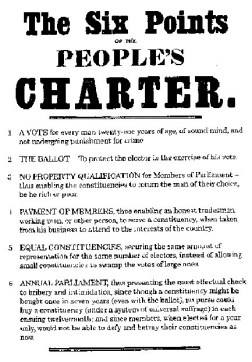
peoples-charter
People’s Charter 1838

On 13th September 2016 BBC Newsnight ran an item on the proposals for changes to Parliamentary constituencies issued by the Boundary Commission for England . One of the interviewees was Chris Skidmore MP, Minister for the Constitution, who referred to the People’s Charter of 1838 to lend legitimacy to the proposals. During the course of the interview he made the statement:

‘The Chartists, who are heroes to some people on the Labour benches’.

Unwarranted Legitimacy

It would be positive, but possibly naïve, to think that the 19th Century Chartists should be heroes to all who claim to be democrats, meaning not only all the Labour Party but MPs of any party, including the Conservatives themselves. But there is a problem. The Chartists demand for equal sized constituencies and a much wider suffrage was an integral part of the demands for comprehensive socio-economic reforms to alleviate deprivation and oppression suffered by most working people at that time. Then, as now, political reform was was an essential corollary to social reform and it is disingenuous of Mr Skidmore to merely pluck one of the six points of the Charter and ignore the spirit of the movement behind it.

Skidmore can get away with appropriating Chartists aims for a narrow political point because of the lack of knowledge about our radical history which I posted about a few weeks ago. But it may surprise him to learn  that genuine support for Chartists and other radical groups is far from unknown within his own Conservative Party. Prime Minister Benjamin Disraeli expressed sympathy with Chartist aims and in 2013 David Skelton of the Conservative Party’s Renewal group published this call for greater education about the history of radicalism including Levellers and Suffragettes as well as Chartists.

The issues surrounding the Boundary Commission proposals which the Government is determined to pursue are complex,  including disputes over how to measure the size of a constituency.  There have been claims that it represents gerrymandering on the part of the Government but I argue that it goes much further than this, serving to distort the very nature of democratic representation while showing profound disregard for social justice. Even allowing for the shrinkage in the number of MPs from 650 to 600 the Conservatives on some estimates would have an increased majority of 22 in the Commons based on the new boundaries. This increase would serve to exacerbate an already unfair system where a Government elected by only 37% of actual voters command a disproportionate amount of power, with an even more pronounced marginalization of Green and UKIP voters To enforce these boundary changes without instituting some form of Proportional Representation as an absolute minimum is undemocratic bordering on reckless.

Political Change is Integral to Wider Social Change

The fact that systems of voting are integrally bound up with socio-economic problems was brought into focus during the Brexit vote where many disaffected people took the opportunity of registering a protest vote. But it is not the job of the Boundary Commission to take wider political factors into account. That is the job of the government and they must not dodge their responsibilities to fairness and democracy. During the 1830s the Chartists chafed against the petty pretensions of the property owning classes which aped the mores of the aristocracy, debasing workers socially as well as economically. Demands for a voice in Parliament had an egalitarian as well as an economic base.   Society has changed radically and deference to the aristocracy has declined, being replaced by the overt greed of owners such as Philip Green and Mike Ashley who debase their workers by flaunting knighthoods, peerages and gross conspicuous wealth. The malaise is now affecting public bodies as this article on the activities of Coventry University and its Vice Chancellor testify. So the sense of injustice persists and Mr Skidmore will be well advised to consider it in his plans. As Paul Mason points out in his book Postcapitalism the Chartists confronted an industrial economy trapped within an aristocratic state. Today we have a low-wage service and knowledge economy trapped within an oligarchic state. Simply manipulating the electoral system to pursue an ideal of fairness within a narrow definition will lead to further instances of protest which may make the Brexit vote appear a mere inconvenience by comparison.

As Sean Monaghan in Jacobin Magazine writes::

A renewed Chartist movement would, for starters, demand the extension of the franchise to all those who lack it. But it would also embrace one of Chartism’s seminal contributions to the history of working-class movements: the necessity of political struggle for popular emancipation.

Government Ministers would do well to remember this rather than cherry pick ideas for narrow party gain.

Could City States Be The Solution to Britain’s Obsolete Constitution?

When the history of our present time is written the Iraq War may not be viewed as the most significant ‘legacy’ of Tony Blair for the people of the UK itself. Instead, historians may focus on the policy of devolution and the dangerously unstable constitutional arrangement. Aside from the unresolved and patently unfair West Lothian Question we have a Scottish Parliament which can legislate unless specifically prevented from doing so, a Welsh Parliament which can only legislate unless specifically authorised to do so, and a House of Lords where Church of England Bishops can affect legislation for everyone! Devolution has left a complete mess and singularly failed to achieve Blair’s goal of heading off the momentum for Scottish independence. Part of the problem is an archaic notion of Parliamentary sovereignty which is contributing to a justifiable feeling amongst the people that our Governmental and administrative systems have a lack of control and accountability. While deriving from an understandable impulse, the addition of a specific Parliament for England will only serve to muddy the waters of accountability even further. The whole idea of devolution should be seen as a mistake and a new way urgently sought out of the mess.

Until now the people of the English regions have shown little enthusiasm for federalism within England itself, largely due to the unpalatable and ‘take or leave it attitude’ of Westminster politicians anxious to be seen to be doing something rather than possessing a real reforming zeal. But that is changing and England itself may be starting to show the way forward for our ridiculous constitution. Significant powers are being allocated to groups of local authorities in areas such as Greater Manchester and the West Midlands and prominent politicians are showing an interest in regional governance. Presently, it is not intended to create new assemblies as with London, with mayors comprising the sole directly elected component. To some extent, however, the new mayoralties resemble embryonic regions, or more realistically considering their focus, city-states. To a civic republican the current model is unsatisfactory (I do not want elected monarchies!) but, suitably evolved, it could provide the seed for a properly accountable federal system.

Continue reading “Could City States Be The Solution to Britain’s Obsolete Constitution?”