The Bill of Rights: why the army is ‘British’ and not ‘Royal’


Have you ever wondered why we have a British Army and not a Royal Army or what happened to the Divine Right of Kings?

On December 16th 1689 the Bill of Rights was finally passed as an Act of Parliament (although it had been declared in statutory form since February of that year). This effectively established England as a Constitutional Monarchy with the King or Queen under firm Parliamentary control. Although there were many consequences of the Act I want to point to just two.

Firstly the Bill specifically prevents the monarch from raising an army unless Parliament agrees. The Bill states:

That the raising or keeping a standing army within the kingdom in time of peace, unless it be with consent of Parliament, is against law;

Continue reading “The Bill of Rights: why the army is ‘British’ and not ‘Royal’”
Remembering Dora Marsden: Suffragette Anarchist

A few weeks ago I wrote a short post about Constance Markievicz, suffragette and the first woman to be elected to the House of Commons (though she never actually took her seat). But there are some people for whom the passion for change burns so strongly that it brings them into conflict even with the cause they espouse.  Such was the case with Dora Marsden who died today (13th December) in 1960.  Marsden operated from Manchester and occupied a position on the radical activist wing of the suffragette movement, frequently engaging in illegal activities. From 1909 she accepted a post in the Pankhursts Women’s Social and Political Union (WSPU) but her assertive campaigning style resulted in frequent conflict with the organization hierarchy.

Splitting with the WSPU in 1911 she pursued a  literary path, founding the Freewoman, the New FreeWoman and Egoist journals. She gave voice to many radical authors who challenged accepted notions of society such as the role of marriage. It would be fascinating to know how she would have viewed same-sex marriage! Another important radical thinker who must NOT be eclipsed by the establishment historical narrative.

John Osborne: looking back at a rebel

The brilliant and controversial British playwright John Osborne was born on 12 December 1929. Possibly his most transformative work was his 1956 play Look Back in Anger. Despite being associated in his early life with left wing politics, he claimed to hold to no firm political views. In his later life he turned towards a libertarian right wing stance, To his eternal credit, Osborne openly questioned the existence of the monarchy in his contribution to a book called Declaration. This was in 1957, a far more deferential age than 2015 and it got him into trouble! The chairiman of the English Stage Company industrialist Neville Blond was furious and a party to celebrate the publication of Declaration at the Royal Court Theatre was cancelled. Ironically, the ESC was no stranger to controversy itself. But I completely agree with Osborne:

My objection to the royal symbol is that it is dead; it is the gold filling in a mouthful of decay.

Shelley: The Continuing State of Things

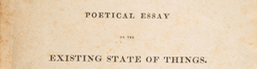
Shelley-Essay-1

Imagine discovering a new set of string quartets by the composer Beethoven. Or perhaps a large canvas by artist JMW Turner that was previously thought to be lost. In either instance, the media would have been all over it. So it is remarkable that the release to public view on 10th November of a major work by their near contemporary, the poet Percy Bysshe Shelley has been met with an air of disinterest, as though it really was not worth the bother. There were brief mentions in the mainstream media (The Guardian newspaper excepted) and some excerpts read out on Radio 4. No comments by Government ministers, including Culture, Media and Sport. But this was an early work by one of this country’s most famous poets!

The work in question is Shelley’s Poetical Essay on the Existing State of Things written in 1811. The only surviving copy of the poem has remained  hidden from public view in private collections for 200 years. You can now read (and even download a copy) from the Bodleian Library site.  So how did we finally get to read the work?  Poet and ex-childrens Laureate Michael Rosen has been campaigning for the release of the work for some time. Rosen gives his thoughts about the reason for the poem’s suppression and why he campaigned to get it released in this blog post.

Continue reading “Shelley: The Continuing State of Things”