The Queen; 50 Years of Trying to Subvert the Commonwealth!

Royalists were unable to contain themselves during the summer of 2013. Apart from the birth of George Windsor there was also this report in the Daily Mail.  According to the article the Queen was ‘discreetly’ campaigning to make the Head of the Commonwealth a hereditary position. Apparently this included getting David Cameron to speak to the other Commonwealth leaders at the Commonwealth Heads of Government Meeting 2013 (CHOGM13).  Now, it must be said that the Daily Mail has been known to get things wrong! There was certainly nothing in the final communique, but maybe that was because it was very discreet. But lets make the entirely reasonable assumption the story is correct. Such an assumption is supported by the royals own website which deliberately confuses matters by having a Role of the Monarchy on its Commonwealth page. The Queen may currently be Head of the Commonwealth as a person but that is not true of monarchy as an institution. The idea that anyone could be promoting the extension of hereditary privilege in the 21st Century is simply disgusting. Furthermore, the fact that a change in the constitution of an international organisation would be attempted ‘discreetly’ shows the complete lack of respect that the Windsor family has for Commonwealth citizens.

The Mail was indeed correct in stating that the words ‘does not pass automatically to her heir’ had been removed from the Governance section of the Commonwealth Secretariat. The site, however, still emphasises the fact that the Head is chosen collectively by the member states.  What gives the story credence is that the Queen had already attempted to make the Head of the Commonwealth a hereditary position.  When the Letters Patent were issued in 1958 to make Charles the Prince of Wales it was intended that he, along with his heirs and successors, shall be future Heads of the Commonwealth!

Continue reading “The Queen; 50 Years of Trying to Subvert the Commonwealth!”

Brexit; We Need Radical Policies Urgently, Not Ignorant Careerists

Article50

The most shocking thing about the Brexit vote has not been the result but the collective failure of the political class to give any sort of coherent leadership.  Instead, we have witnessed, by turns, politicians frozen like rabbits in headlamps.  Look at the facts, chief dissembler Boris Johnson, supposedly intelligent appeared the morning after the vote, said nothing and scuttled away.  David Cameron blubbed to the media and similarly retired hurt, but bear in mind he still has responsibility as Prime Minister! Chancellor George Osborne simply did not appear at all until Monday morning when he popped up with neither clue nor plan but long on soothing platitudes. The rest of them including Michael Gove just responded by a starting to think about their careers and a leadership election.  Some commentators have called it Machiavellian, but having spent a little while looking at the work of ‘Old Nic’ I reckon he would most probably have been appalled at the incompetence! All the Parliamentarians, including the Labour party self declare as democrats but are prepared to risk leaving a dangerous power vacuum.  There were even calls, not serious ones admittedly, for the Queen or Army Generals to take temporary charge! A few weeks later and their democratic credentials look even thinner with the Conservative Party preparing to elect a new leader and thus Prime Minister from an electorate of only 150,000 without the guarantee of a General Election and the possibility of rowing back from the Brexit vote (Article 50 will not now likely be triggered until at least 2017).

A Failure of Planning and Understanding

A almost incredible facet of the referendum result was the total lack of planning for a leave vote.  Racist incidents soared, the currency and stock markets collapsed and international collaboration immediately started to freeze or be terminated.  But no one took control and we are far from out of danger, in fact the danger will actually intensify. This was the inevitable outcome of the debate which was criticised in earlier posts here and here. I do not buy the argument that we will experience some volatility before things settle down. As things transpired only the SNP in the shape of Nicola Sturgeon were anywhere near prepared for the result.  No wonder the SNP virtually monopolise Scotland, a state of affairs which does them credit but bodes ill for contestable politics in the UK.  Here is why I think this is the case.

Continue reading “Brexit; We Need Radical Policies Urgently, Not Ignorant Careerists”

The Royal Oath; An Invidious and Deceptive Anachronism

An oath is a formal declaration or promise to carry out an action or maintain a pledge. Many oaths call on God or a sacred object to act as a witness and most involve allegiance to a person or cause.  Oaths are made all over the place, many in a legal context. Such is the nature of the oaths which our MPs, military personnel (except the Royal Navy!), police officers and other public officials must make to the Queen. As the Republic group points out it is a complete affront to the spirit of democracy that our elected representatives have to swear allegiance to an unelected monarch. Here is the oath which our MPs must take.

I (MP name) swear by Almighty God that I will be faithful and bear true allegiance to Her Majesty Queen Elizabeth, her heirs and successors, according to law. So help me God.

There are some variations which can be taken, such as a non-religious equivalent, but the substance is the same in all cases. Note that until they take the oath they cannot represent you or I and do the job for which they were elected. As I have pointed out earlier, this has been, and still is, a problem for some Irish political parties.

There are two things to note about the oath.  Firstly is the assumption that the monarch embodies the state in person and thus represents us all in a kind of social contract.  The fact is that this is a constitutional figment which has been abused for centuries is beyond dispute (see here,paragraph 3).  The difference is that whereas in previous centuries this abuse has taken the form of political or military oppression, in modern times this privilege takes the form of protections for private interests, such as mineral rights.

Continue reading “The Royal Oath; An Invidious and Deceptive Anachronism”

‘Taking Back Control’; Sounds Fine if You Like Illusions

Crowned_Portcullis_Med

On the face of it the Tesco Superstore in Consett, Co. Durham is not the most obvious place to gain insight into the EU referendum debate. On the other hand, it is as good a place as any (including Westminster and Whitehall), which gets to the heart of the problem. I popped into this particular store a couple of week ago while paying a visit to the area and while queuing to check out, overheard a young man operating an adjacent till enthusiastically explaining to his paying customers why he was voting to leave. It was, he confidently asserted, all about sovereignty, about taking back control. This set me thinking about the multi-facetted layer of the debate and the way in which ‘taking back control’ has eclipsed the Remain campaign’s point about protecting the rights of part-time and low-paid workers.

‘Taking Back Control’ – to Where?

The deliberate conflation of sovereignty with taking back control is only possible due to the depressing lack of understanding amongst many people of even the rudiments of the British constitution. The intention of the Leave campaign is to give the illusion that somehow we are all in control, an illusion of popular sovereignty fostered by the holding of the referendum itself (Ben Wellings and Emma Vines have pointed to this irony).  Theoretically, sovereignty the UK is exercised by Parliament with the role of the people limited to choosing their representatives to exercise this sovereignty.  Under normal circumstances the young man at the Tesco checkout would have very little power unless he got himself elected, or elevated to the peerage, and even then his power would be limited.  But even those who proclaim the supposed sovereignty of Parliament are being misleading and in fact the UK has a long history of internally sharing sovereignty.  As a prime example, the Scottish legal system operates on a completely different set of assumptions to the system in England and Wales. In modern terms the Parliaments and devolved assemblies of Wales, Scotland and Northern Ireland all share some of the Sovereignty of Parliament along with the English judiciary (through the system of common law). The official website provides more information on the number of ways in which it actually shares sovereignty with other sources of UK power. For a more complete account of the background to shared sovereignty, David Allen Green has written this excellent post.

So far I have considered  the UK in isolation. But we are signatory to approximately 700 or so international treaties, each of which involves a sharing of sovereignty to a greater or lesser degree.  Three of the most prominent agreements of course are the North Atlantic Treaty Organization (NATO) United Nations (UN) and the European Convention on Human Rights (ECHR).  It could be argued that as the UK parliament could withdraw from any international treaty then it still exercises ultimate sovereignty.  But turning us into a kind of North Korea is not what the Leave campaign advocates. In fact it positively encourages us to be outward looking and even lauds the Commonwealth, which is in itself an expression of shared sovereignty! So the concept of sovereignty is a complex issue with many layers and a troubled history.  David Nowell Smith gives further details of just how slippery is the concept of sovereignty.

Who Would Exercise this ‘Control’?

While acknowledging just how complex the concept of sovereignty can be, it is possible to address some issues surrounding the wielding of power in the UK. Behind the deliberate conflating of sovereignty with ‘taking back control’ is the implicit assumption of an increase in individual liberty.  We have already noted that our checkout person will have almost no more effective power if we leave the EU than if we remain.  One example will suffice to illustrate this important point.  Many Leave campaigners talking about control are actually alluding to one aspect, immigration.  The argument is that withdrawing from the EU will necessarily drastically slow immigration leading to both higher wages and more resources for all of us in terms of public services.  But this is a deception. With sovereignty resting with Parliament and government being elected on a minority of the voters (the current one by only 37%, 24% if you include non-voters) there is no reason why a right wing government could not skew immigration to provide a constant flow of workers into just those industries to keep wages suppressed. Likewise there is no guarantee that more will be spent on public services, austerity may well continue and services privatised. Don’t forget, the Government has been stocking the Lords with wealthy businessmen interested in making as much money as possible.

Continue reading “‘Taking Back Control’; Sounds Fine if You Like Illusions”

The House of Commons Chamber is a Museum Piece Unfit for Purpose

How old is the Chamber of the House of Commons? If you didn’t know, a reasonable guess may be that it is an eighteenth or nineteenth century structure. Although there have been buildings on the site since the 11th Century, the Palace of Westminster as a whole largely dates from the 183os. Surprisingly, however, the fabric of the present Commons Chamber itself dates from only 1950 when it was rebuilt following destruction in wartime 1941!

The striking thing about the EU referendum debate is the way in which politicians from all parties have been willing to share a platform. But this is not exceptional with the Parliamentary committee system allowing politicians to work together to achieve mutually agreed goals. This is at odds with the undemocratic charade to which Prime Ministers Questions has now descended in the main Chamber. In the current disillusionment with politics and the political establishment, one problem which is often overlooked is with the structure of the Chamber of the House of Commons itself. You can view the layout using this very good interactive guide. Incredibly for our main legislative chamber it can only seat 427 of the 650 MPs! The situation is exacerbated when the governing party (or coalition) has a substantial majority flooding one set of Chamber benches.

In terms of layout, the format of two banks of benches facing each other is, appropriately enough, known as Westminster Style. Considering the problems associated with this arrangement very few new legislative chambers are designed in this way. What are the problems? Firstly it does not facilitate good debate, partly because it encourages a confrontational approach between Government and Opposition often leading to the unseemly jeering and barracking with which we are all depressingly familiar. Moreover, exchanges between members on the same side is hampered by the fact that participants cannot see each other easily when arranged side-by-side.

Continue reading “The House of Commons Chamber is a Museum Piece Unfit for Purpose”

A One-Sided Approach to Press Freedom is Threatening Our Liberty

In an  earlier post I mentioned that the theme of  Levellers Day 2016 was (Un) Civil Liberties.  This covered, amongst other subjects, the issue of press freedom, a difficult topic largely due to the inclusion of the word freedom!  The philosopher Isaiah Berlin identified over 200 ways in which the word ‘freedom’ has been used, leading him to conclude that it had become almost meaningless in practical terms, unless qualified in some way. Even in 1948 the United Nations must have realised the asymmetry of the clause in the Declaration of Human Rights which reads:

Everyone has the right to freedom of opinion and expression; this right includes freedom to hold opinions without interference, and impart information and ideas through any media regardless of frontiers. 

But what about the right of each of us to be exposed or made aware of such ideas? Here is the essence of the problem.

As with most issues involving freedom the first questions to arise include freedom from what or, alternatively, freedom to do what?  These issues lay at the core of attempts following the Leveson enquiry to regulate the press. A balance needed to be struck between protecting the freedom of the press from political interference against the freedom of the general public from unwarranted invasive press intrusion.  In a real sense the press brought the problem on themselves with outrageous phone hacking and payments to officials such as the police. So the insidious activity of phone hacking and backhanders to gain a commercial or competitive advantage was inextricably wrapped up with the laudable aim of furthering the public interest by revealing wrongdoing in Government.  As reported here, many newspapers including the Daily Mail were vocal in opposing the setting up of a ‘voluntary’ self regulating body (Independent Press Standards Organisation, IPSO) via a Royal Charter as it carried the implicit danger of interference from politicians.

But it is now important to ask what the press does with its ‘freedom’. Who is the beneficiary? This has been brought into sharp relief this month (May 2016) when the issue of alleged Conservative party fraud involving election funding has gone virtually unreported by many of those originally crying foul over the Press Charter including the aforementioned Daily Mail, but also Murdoch’s The Sun and The Times, the Daily Express and Metro amongst others  The situation is so ludicrous that ex-Conservative party Minister Michael Portillo claimed on television that he was completely unaware of the alleged fraud.  This is despite investigations by a number of police forces carrying the possibility of forced by-elections which may mean the loss of the Conservative Government Commons majority.  Clearly press freedom does not benefit Michael Portillo!

Continue reading “A One-Sided Approach to Press Freedom is Threatening Our Liberty”

Levellers Day; Radical Politics, Sunshine & Extreme Morris Dancing!

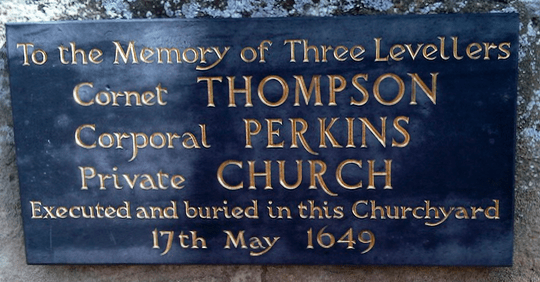
Levellers plaque

The sun always shines on Levellers Day. Look, I am as big a fan as anyone of Tom Paine’s The Age of Reason, but I have empirical evidence! Just in case you are new to my blog and require a little orientation as to the 17th Century Leveller movement, the Levellers Day site briefly explains what it is all about. For more details you can download a book from this site and I covered some aspects of the events of 1649 and their relevance to today in a recent blog post.

For me the day always starts with a lovely drive down from the Midlands along the Fosse Way and through the Cotswolds to Burford. I was delighted to be a ceremonial pikeman again this year so following a quick chat to my fellow Republicans it was away to the main tent to don my repro Civil War uniform.  Walking down to the Church from the Recreation field is always an amusing experience with smiles mixed with some bemused looks from tourists who are unaware of the significance of the day.

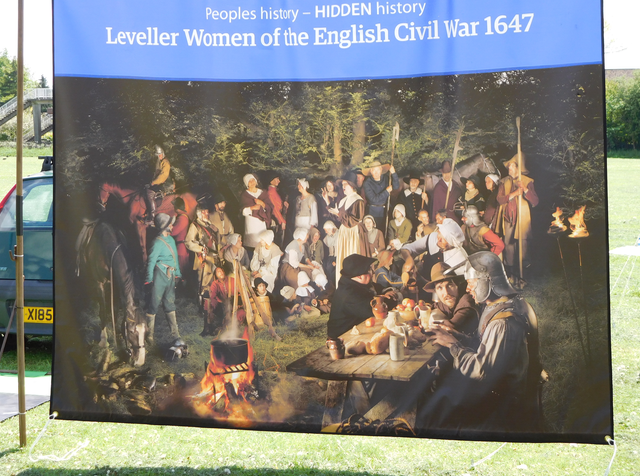
LevellerWomen

At the Church I meet up with my fellow Pikeman and Pikewoman to a welcome from the Sea Green Singers who open the proceedings splendidly with songs about the fight for tolerance and civil liberties covering over three centuries! Predictably, I loved their one about William Cobbett trying to repatriate Tom Paine’s bones (Cobbett was a truly fascinating character – learn a little more here).The address by Reverend Mark Chapman was as thought provoking and inclusive as always, managing to nail the common ground between people of many faiths and no faiths. This is followed by the laying of commemorative posies, a minute silence and a prayer from the Reverend.

Then we form up for the start of the procession – everyone is friendly, relaxed and in good spirits while we wait for the road to be closed. Once again we are marching up the hill all the way to the Recreation Ground.  With my fellow Pikeman, along with Rev Chapman and the Levellers Day banner bearers we closely follow the leading Morris dancers and marvel as they manage to keep going up the long drag. Extreme Morris Dancing for sure!

Levellers16


At the ground, a huge variety of groups are represented; Communists, Socialists, NHS supporters, Veterans for Peace, Trade Unions, the Woodcraft Folk to name but a few.  This year the Republic stall was even more popular than last year and I forewent the debate to help persuade more folk of the need to end inherited privilege.  This year the theme was (Un) Civil Liberties covering free speech and human rights. Friends tell me the debate was well up to the usual standard and I expected nothing less from the speakers involved! You cannot possibly agree with everyone and that is partly the point! But there is no doubt that the enthusiasm and commitment of others who have a passion for a different form of society, however they conceive it, is wonderful. There is an energy you can draw from this to recharge batteries for the campaigns in the year ahead. I am always grateful to Trish and her colleagues for the immense amount of work put into the day. A gorgeous time is finished off for me with a lovely drive back along the Fosse Way.

RepBrumLevellers

The inspiration from the day will last for a long time and it has already sparked fresh ideas and plans from the Republic Birmingham crew! If you’ve not experienced Levellers Day do come along to Burford next year. Its on the 20th May – put it in your calendar.

Supporting David Cameron is Incompatible with Supporting Democratic Principles

Last month I blogged about the imprisonment and trial of four Levellers (for details of the Levellers see here) in March 1649 for publishing a pamphlet (England’s New Chains Discovered) which dared to criticize Oliver Cromwell and the military government. In effect this was the start of a determined programme of suppressing opposition and avoiding accountability which lay at the heart of the concerns articulated in the pamphlet. The warning which the event hold for us today was starkly illustrated a few weeks ago during Prime Ministers Questions in the House of Commons. This is supposedly a central event in British democracy where the Prime Minister is held accountable by our representatives. While all Prime Ministers in recent times have been known to dissemble, David Cameron has established a special notoriety for ignoring questions. In this instance he did it with a persistence, arrogance and contempt for the House of Commons which defied belief.

Continue reading “Supporting David Cameron is Incompatible with Supporting Democratic Principles”

England’s New Chains Discovered: A Moment in History, A Warning To Us

Englands New Chains (1)
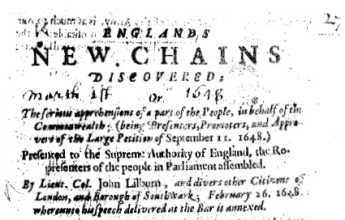
England’s New Chains Discovered

Last March (2016) I visited the Houses of Parliament for the launch of the We The People campaign for a Citizens Constitutional Convention. Like most visitors I entered through the Cromwell Gate right past the statue of the man himself.  It was a moment of reflection, with Levellers Day approaching (on 14th May 2016, more here) and the issue of democracy and accountability which it inevitably raises.

There is much popular misunderstanding about Oliver Cromwell and people are often confused about his place in history, asking whether he should be viewed in a positive or negative light. The unhelpful answer is both, depending on which aspect of his career is under consideration. As a reformer of the English Civil War Parliamentary forces during the creation of the New Model Army he was invaluable. In particular his organisation of the cavalry wing, the Ironsides was a crucial development in the eventual triumph of Parliament. But increasingly after 1648 he behaved in an autocratic manner, crushing tolerant and democratic forces (such as commemorated at Levellers Day) and culminating in the replacement of the Commonwealth by the Protectorate.

The increasingly repressive methods of Cromwell and his associates such as son-in-law Henry Ireton can be illustrated clearly in one event, which also serves as a warning to us. On March 28th 1649 four Levellers, John Lilburne, Richard Overton, Thomas Prince and William Walwyn were arrested for publishing (on February 26th 1649) a pamphlet called England’s New Chains Discovered (you can read a transcript here).  It was a clear and unambiguous criticism of Cromwell and outlined the dangers to liberty of the military government.  A crucial worry for the Levellers was the status of the so-called Council of State, the body set up to replace the Privy Council following the execution of the King and declaration of a Commonwealth in 1649. Set up by the Rump Parliament (you can view a transcript of the Act here), its 41 members were appointed rather than elected and Cromwell was its first Chairman. The dangers of such an arrangement were clearly laid out and included the ability of the Council to dissolve Parliament (then consisting of just the House of Commons, the Lords having been abolished) without the necessity to immediately call the next. Another grievance involved the ability of the  Commons to create or abolish Law Courts and so subvert the jury system which was regarded as the bedrock of justice. Likewise, the ability of MPs to be the ‘highest final judgement’ was viewed as particularly heinous as it placed them beyond the control of the laws they were enacting. That lawmakers should be subject to the laws they enact is regarded as a vital brake on any system of representative government. Central to all of this was the way in which senior army officers could sit in the Commons thus supporting military rule.

Continue reading “England’s New Chains Discovered: A Moment in History, A Warning To Us”

Whether By Incompetence or Malice, Muzzling Scientists is Bad News

It is sometimes difficult to decide whether a Government decision was the result of incompetence or an unscrupulous attempt to suppress debate.  Since we are frequently kept in ignorance, the viewpoint I take often depends of the charity of my current mood. It was revealed by the Observer newspaper in February (in this article) that the Cabinet Office was imposing new rules from May 1st 2016 which would effectively censor recipients of Government grants from using their results to lobby for a change in policy.  After a high profile protest by senior scientists, including the Astronomer Royal Sir Martin Rees, the Government has partly backed down (report here).  The problem is that the wording of the exemption is so imprecise that a researcher may be tempted to abandon a funding application for fear of contravening the rules. Likewise the sanction for such a contravention was not made clear

Why is this important? Firstly, it is the duty of all Governments to protect their citizens, not least from their own policies  and evidence of such harm must be made public.  The attempt to control and suppress such information is redolent of corrupt totalitarian regimes such as Nazi Germany or Stalinist Russia. Secondly, the Government Minister (in this case Matthew Hancock) seems to have forgotten that it is our money – there is no such thing as Government money. As I argued in an earlier post The Enlightenment of the 17th and 18th Centuries was built upon the ability to question and challenge authority using reason and argument.  This remains true today and public bodies have a duty not to restrict the ability of its citizens to access information which informs such debate.  There are many topics at the present time where the evidence is hotly contested, not least in Climate Change, Defence and Social Policy. So do I think the Government is bring incompetent or acting with malice? The original decision to muzzle scientists could be viewed as incompetent but the way in which the Cabinet Office is confusing the situation rather than making a clean retraction is inclining me to view the aim as yet another devious attempt to stifle opposition.