In 1647 Leveller Thomas Rainborough (1610-1648) made this statement:
…I think that the poorest he that is in England hath a life to live, as the greatest he; and therefore truly, Sir, I think it’s clear, that every man that is to live under a government ought first by his own consent to put himself under that government; and I do think that the poorest man in England is not bound in a strict sense to that government that he hath not had a voice to put himself under.
I consider it one of the most profound statements on political philosophy uttered in the English language. Here’s why.
Rainborough was a Colonel in the Parliamentarian army during the English Civil Wars. As a leading member of the radical Levellers group he took part in the momentous 1647 Putney Debates, a series of discussions, sometimes stormy, between the grandees of the New Model Army and the Levellers regarding a new constitution for England.
Although often discussed in terms of wealth inequality, Rainborough’s choice of the phrase life to live has far greater scope and is fundamentally important today. When international bankers such as Goldman Sachs or JP Morgan can invite Theresa May or Hillary Clinton to their events or Charles Windsor as heir to the throne can simply invite the Prime Minister of the day around for tea, ir represents an influence which the poorest he cannot even contemplate bringing to bear on the UK Government. It is true that we must beware of ascribing too much of a modern interpretation to Rainbrough’s. statement. the possibility of votes for women (poorest she!), for example, would not even have been considered at that time.
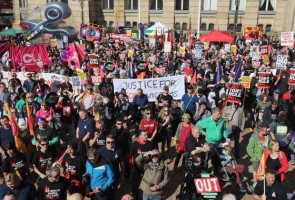
Yet as a claim for an inclusive society where decisions of the powerful can be contested his quote is as powerful as ever and entails what political thinker Philip Pettit calls the ‘eyeball’ and ‘straight talk’ tests. The eyeball test means all members of a society should be able to look each other directly in the eye as equals while the straight talk test means that we can all express our reasonable opinions to those in power without fear of recrimination. Sadly many western societies are failing these tests.
Consider, for example, the current political upheavals which politicians such as Bernie Sanders in the US attribute to the rise of oligarchical power. It has been noted that contrary to popular opinion oligarchies often control governments without the direct use of money, although they are closely connected. What initially starts as unequal wealth slowly morphs into the subtle means of control characteristic of a class system. Money buys the children of the wealthy smart new clothes, a childhood in fine homes, access to exclusive education where networks can be formed and travel across the world. This breeds confidence and slowly the class structure emerges as exists in Britain, has emerged in the United States and is now emerging in Russia. An expectation, frequently granted, of political and economic influence flows from this added confidence.
So Rainborough was absolutely correct. A life to live involves more than simply wealth inequality no matter how significant that may be.
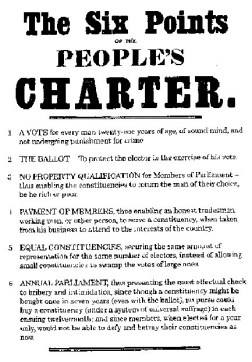
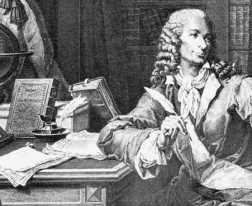 If you have read some of my previous posts you may be aware that I rarely write about foreign radical thinkers. Even when I do they are mainly in the Anglophone tradition such as American Thomas Jefferson, the major exception being Niccolo Machiavelli. There are two reasons for this bias. Firstly, other countries such as France with a less moribund and self-protective establishment than Britain tend to be more open about radical proponents of the past and are better known as a consequence. Secondly, possessing woefully poor foreign language skills I am dependent upon published translations of major works. Where nuance and opinion are all important, the subtleties of language are vital and easily lost or distorted as they cross language barriers.
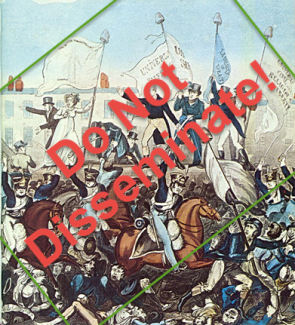 When I was 11 years of age I had a wonderful history teacher. We studied the Anglo-Saxons and he did his best to give us an idea of what it was like to live about 1,500 years ago. It was compelling stuff but sadly it did not last. By age 14 I had given up on history, my early inspirational teacher being replaced by a boring and lifeless one who made us learn facts and dates by rote. It would be many years before I started to realise that to understand our present situation we need to understand where we have come from. I also realised that the history I wanted to grasp was not the history taught in schools or on the TV and there were few monuments to the events I found significant. I learned quickly about the way in which the establishment controls the historical narrative. I wanted to understand the fight to be a free citizen, the struggle for liberty, the campaigns for equality and a fair wage. But the overwhelming narrative was about monarchs, wars, generals and empires. It was easy to find out why the Duke of Wellington was a hero of Waterloo, but not that he was despised in many places and physically attacked on the streets for his repressive attitude and support for the 1819 carnage in Manchester at the
 New Leveller